Expertise
4 min reading
3 January 2022
3 January 2022
Industrial IoT: Understanding the Basics


The Industrial Internet of Things (IIoT) is a network of connected machines, sensors, gateways, and software that collect and exchange data across industrial operations to make them safer, more efficient, and more cost-effective. It is the engine behind Industry 4.0 — applying the same connect-and-analyze principle as consumer IoT, but to manufacturing lines, mining sites, supply chains, and other demanding environments where reliability and uptime are critical.
If you’re exploring IIoT for your business, it’s easy to feel overwhelmed by the terminology and the technology choices. At TEKTELIC, we’ve spent over two decades building IoT and LoRaWAN® solutions for industrial operators, and in this article we want to share that expertise with you. Continue reading to learn what IIoT is, how it works, how it differs from consumer IoT, where it’s used, and how to get started.
What Does IIoT Stand For?
IIoT stands for the Industrial Internet of Things. It refers specifically to IoT technology applied in industrial settings — factories, plants, warehouses, mines, and field operations — as opposed to consumer devices in the home. You’ll sometimes see it written as “Industrial IoT” or “industrial internet of things”; all three refer to the same concept.

What Is the Industrial Internet of Things?
At its core, the Industrial Internet of Things is an ecosystem of interconnected objects, each able to join a network, collect data, and share it for analysis. Smart sensors continuously monitor your physical assets — tracking temperature, pressure, vibration, location, and other metrics — and stream that data to a cloud platform where it’s analyzed in real time.
The result is visibility that was previously impossible. Instead of relying on schedule-based maintenance and manually collected data, your operations team gains a live view of equipment health. That shift lets manufacturers maximize uptime, lower maintenance costs, reduce unproductive periods, and improve product quality. And because the data is shared instantly with everyone involved in plant operations, decisions get faster and more accurate.
In short, IIoT lets people, machines, and software communicate and cooperate — making industrial processes faster, cheaper, and more reliable.
How Does Industrial IoT Work?
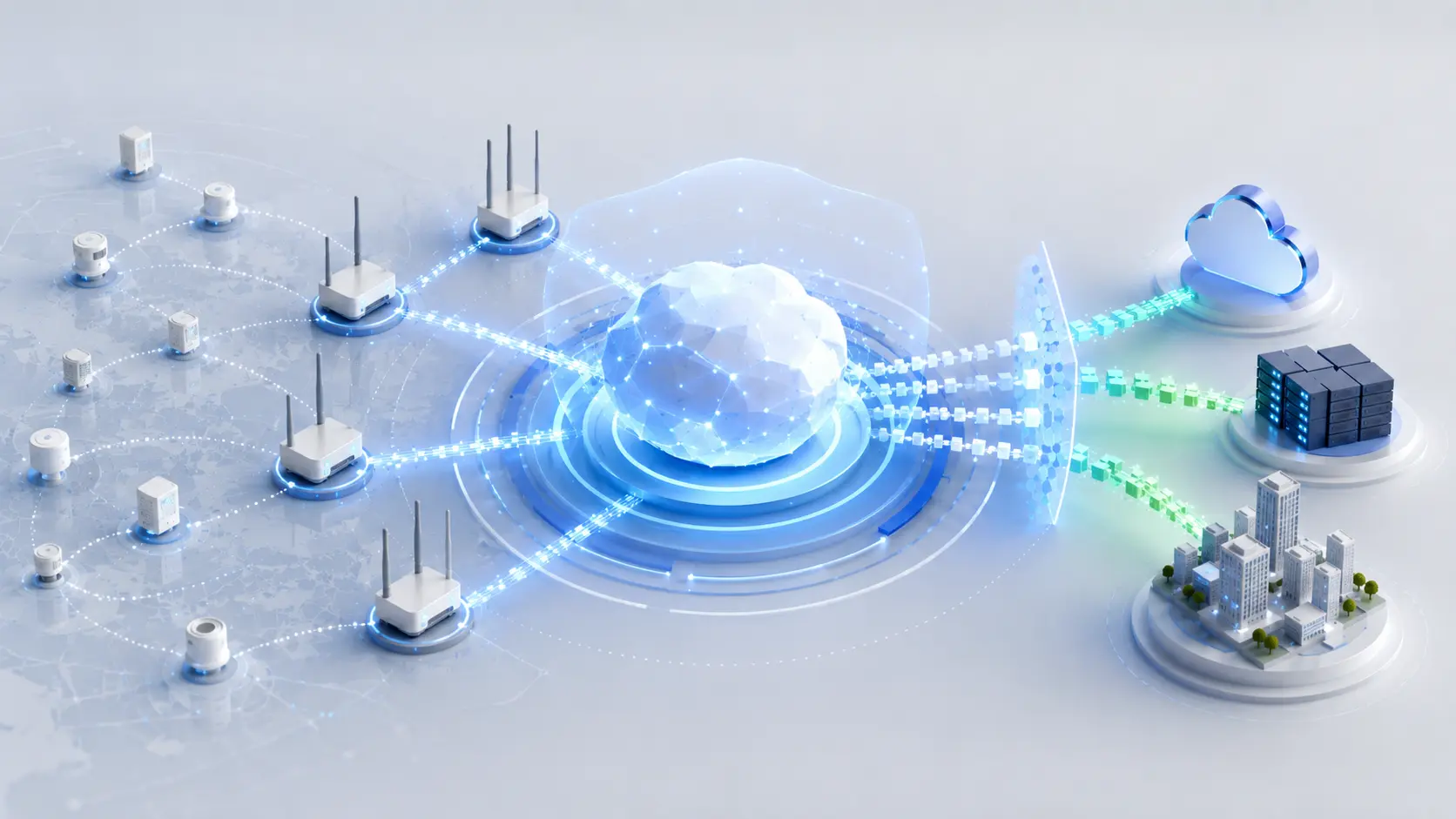
An industrial IoT deployment generally moves data through four layers:
- Edge devices and sensors. Rugged sensors and smart devices are attached to machines, vehicles, or infrastructure. They capture raw operational data — temperature, pressure, vibration, GPS position, and more.
- Connectivity. Those devices connect to a network and transmit their data. Because industrial environments are demanding, IIoT typically relies on robust, long-range, low-power protocols such as LoRaWAN® rather than the lighter connectivity used in consumer IoT.
- Platform and cloud. Data flows to a cloud platform for storage and processing, where it can be accessed remotely from anywhere.
- Analytics and action. Analytics and machine learning turn the raw data into actionable insight — flagging anomalies, predicting failures, and triggering automated responses or alerts.

Connecting machines to an IP network and setting up regular data analysis is comparatively straightforward, which is part of why adoption is accelerating. Once in place, the system continuously monitors the condition of every connected asset and surfaces problems before they cause downtime.
IIoT vs IoT: What Is the Difference?
IIoT is a specialized branch of IoT. Both technologies “speak the same language” connected devices collecting data and acting on it — but they differ in purpose, hardware, and the stakes involved. Consumer IoT prioritizes convenience; industrial IoT prioritizes reliability, scale, and safety.
nd safety.
| Aspect | Consumer IoT | Industrial IoT (IIoT) |
| Primary purpose | Convenience and comfort | Efficiency, safety, and uptime |
| Typical devices | Inexpensive consumer gadgets | Ruggedized, high-precision industrial hardware |
| Environment | Homes and offices | Factories, mines, supply chains, harsh conditions |
| Reliability needs | Moderate | Mission-critical |
| Security & protocols | Standard | Stronger, more resilient communication protocols |
| Scale & complexity | Lower | Higher — broad visibility and automated controls |
| Consequence of failure | Minor inconvenience | Costly downtime or safety risk |
In practice, IoT uses low-cost connected sensors for consumer convenience, while IIoT uses more sophisticated devices to extend manufacturing and supply-chain systems with broader visibility, automated controls, and advanced analytics. IIoT devices are built for rugged conditions, can be accessed and monitored remotely without human assistance, and demand stronger communication protocols precisely because the cost of failure is so much higher.
Industrial IoT Applications by Industry
The Industrial Internet of Things can transform almost any sector. Most IIoT projects aim to automate, save, or optimize processes — supporting goals like innovation, customer-centric services, and data-driven revenue. Here are some of the industries where we see IIoT making the biggest difference.

Manufacturing
Manufacturing is the flagship IIoT use case. Sensors monitor temperature and pressure to keep equipment within safe limits, detect hazardous conditions and alert workers, and track machine performance to optimize facilities and reduce operational risk. Measured machine signals are a reliable indicator of performance, so monitoring them flags deviations early — protecting product quality and even opening new, service-based revenue models.
Mining
Mining gains enormous value from IIoT. Using cameras, sensors, and underground LTE or LoRaWAN® networks, operations can shift from manual processes to data-driven algorithms. Connecting equipment and vehicles to the cloud lets operators control machinery remotely — even from a smartphone — while AI analytics surface the most important insights to boost productivity and lower costs.
Read more: LoRaWAN® for Mining Operations: Better Connectivity, Lower Costs
Logistics
In logistics, connected devices track and manage inventory, monitor goods in transit by location and condition, and improve worker safety on the road. IIoT gateways, smart machines, and AI applications are now core to modern supply chains — and even aircraft manufacturers use IoT-based security systems to detect issues and improve performance.
Read more: Smart Logistics with LoRaWAN® Technology: Everything You Need to Know
Healthcare
Medical devices require close monitoring, which makes IIoT a natural fit. Applications track components of medical kits and critical healthcare processes. Medical-equipment manufacturer Medivators, for example, reported a 78% increase in handled service issues and events after integrating IoT solutions without adding headcount.
Engineering
For process engineers, IIoT automates the data collection, storage, and visualization that used to be done by hand. With connected operations and wearable devices, teams can focus on improving processes rather than manually aggregating and analyzing data.
Other Industries
IIoT also reaches agriculture, smart cities, automotive, robotics, and even banking — where connected sensors can reveal which ATMs are most efficient and strengthen cybersecurity. Across sectors, IoT reduces lead times, optimizes inventory and asset management, improves energy efficiency, and lowers operational costs.

Key Benefits of Industrial IoT
Predictive Maintenance
Detecting malfunctions early can save millions. IIoT sensors monitor equipment continuously and send alerts the moment something drifts out of range, letting your team act before a small issue becomes a costly breakdown. Automating predictive maintenance reduces manual intervention and provides insight across the entire value chain.
Operational Efficiency
IIoT makes processes leaner by replacing guesswork with live data. The main challenge is integration — operational data systems often weren’t designed to connect beyond the local network — which is why choosing the right IIoT platform matters. Done well, IIoT keeps teams focused on actionable information rather than data wrangling.
Process Optimization
By collecting sensor data in the cloud, you can automate production lines, monitor output remotely, run predictive maintenance, and streamline the supply chain — all while reducing the cost of human intervention. The same data improves workplace safety by letting you monitor conditions and respond quickly.
What TEKTELIC Offers for Industrial IoT
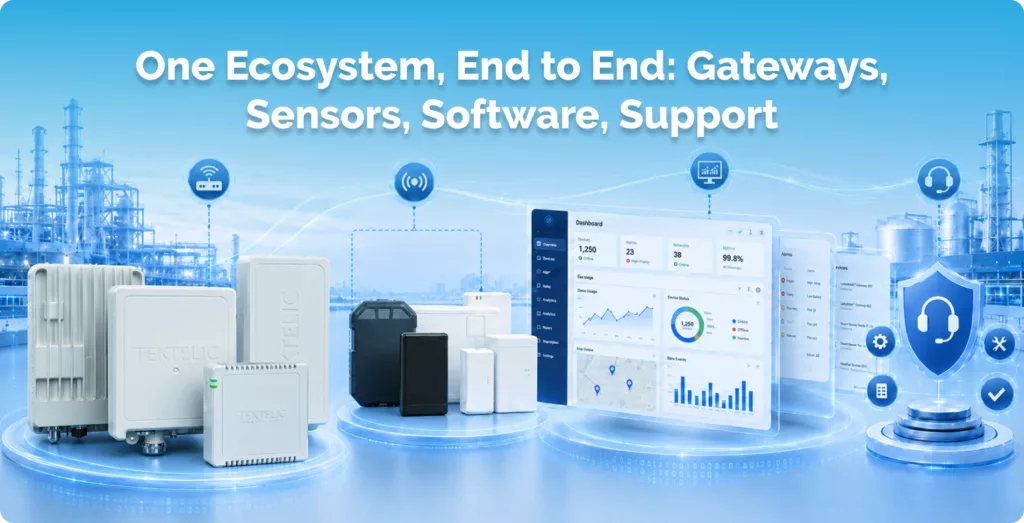
TEKTELIC is a global supplier of complete LoRaWAN® IoT solutions — gateways, sensors, network software, and the expertise to tie them together. Built on 15+ years of wireless engineering and trusted by 450+ clients worldwide, our carrier-grade hardware and end-to-end systems are designed for the demanding, long-life deployments that industrial operations depend on.
Industrial LoRaWAN® gateways
Our KONA gateway family from compact indoor gateways such as KONA Micro to outdoor carrier-grade gateways such as KONA Macro and KONA Mega, as well as KONA Enterprise for enterprise and remote deployments.
Because the hardware is carrier-grade and built to last, you spend less over the life of a deployment: fewer failures, fewer site visits, and dependable uptime you can count on. In practice, that reliability also means covering the same area with 30–50% fewer gateways — lowering both your upfront and ongoing costs. To add more, the gateways connect smoothly with the building and industrial systems you already run, you get value faster without extra complexity.
Industrial sensors & Asset tracking devices
A purpose-built portfolio for monitoring conditions, locating assets, and protecting people in tough industrial settings:
- TUNDRA — keeps watch over temperature and humidity where conditions are extreme, from hot factory floors to cold-chain shipments. Its long battery life means years of monitoring without maintenance.
- ORCA — a tough GPS tracker that shows you where your equipment is, in real time, anywhere in the field. It’s simple enough to set up yourself, holds up in extreme temperatures, and works just as well for managing facilities as it does for logistics.
- SEAL — a wearable tracker that helps keep lone and field workers safe. It pinpoints their location indoors and out, detects falls, and lets them raise an alarm instantly with a panic button. A ruggedized version is certified safe for use in explosive environments.
- CHICKADEE — a lightweight badge that monitors personnel and assets accurately across large sites, indoors and out. It’s quick to hand out and set up — workers are up and running in seconds through a simple app.
- PELICAN — a rugged tracker built to keep tabs on valuable assets in demanding places like factory floors, rail yards, and storage facilities. It survives extreme temperatures, runs for years on a single charge, and comes in a version certified for hazardous sites.
Network Server & Device Management
The KONA CORE LoRaWAN® Network Server lets you remotely provision and manage deployed gateways and devices, with secure data transport, horizontal scalability, and a fault-isolated architecture that has no single point of failure.
Our management ecosystem consisting of the LeapX onboarding app, KONA Link web interface, KONA Atlas payload tools, and LOCUS RTLS solution for centralized geolocation. Covering the full-cycle at Tektelic makes deployment and day-to-day operation straightforward for any skill level.
Prefer your own stack? Our devices are interoperable with standard LoRaWAN® network servers including AWS IoT Core, ChirpStack, Actility, Loriot, and The Things Network.
Professional services & IoT expertise
Beyond hardware, our team partners with you from design through deployment: custom application development, solution architecture, and ongoing support drawn from 15+ years of LoRaWAN® expertise. The result is a robust end-to-end solution engineered around your problem, not a box of parts you have to integrate yourself.
How to Get Started with Industrial IoT
If you’re new to IIoT, our advice is simple: start small. Choose one problem to measure or improve, run a focused pilot, and learn how the technology fits your operation before scaling up. You’ll quickly understand both the technology and how your business can operate with it.
The biggest factor in success is choosing the right partner — a company that supports you, answers your questions, and helps you integrate IoT smoothly. At TEKTELIC, that’s exactly what we do. With two decades of hands-on experience and a global network of satisfied clients, we’re here to make your IIoT project a success.
If you’re looking for a reliable partner to get started with Industrial IoT, contact us today at info@tektelic.com to start your IoT journey.