Articles
5 min reading
7 August 2026
7 August 2026
From Drive-By Meter Reading to a Connected Utility: AMR or AMI, Which to Choose for Smart Metering

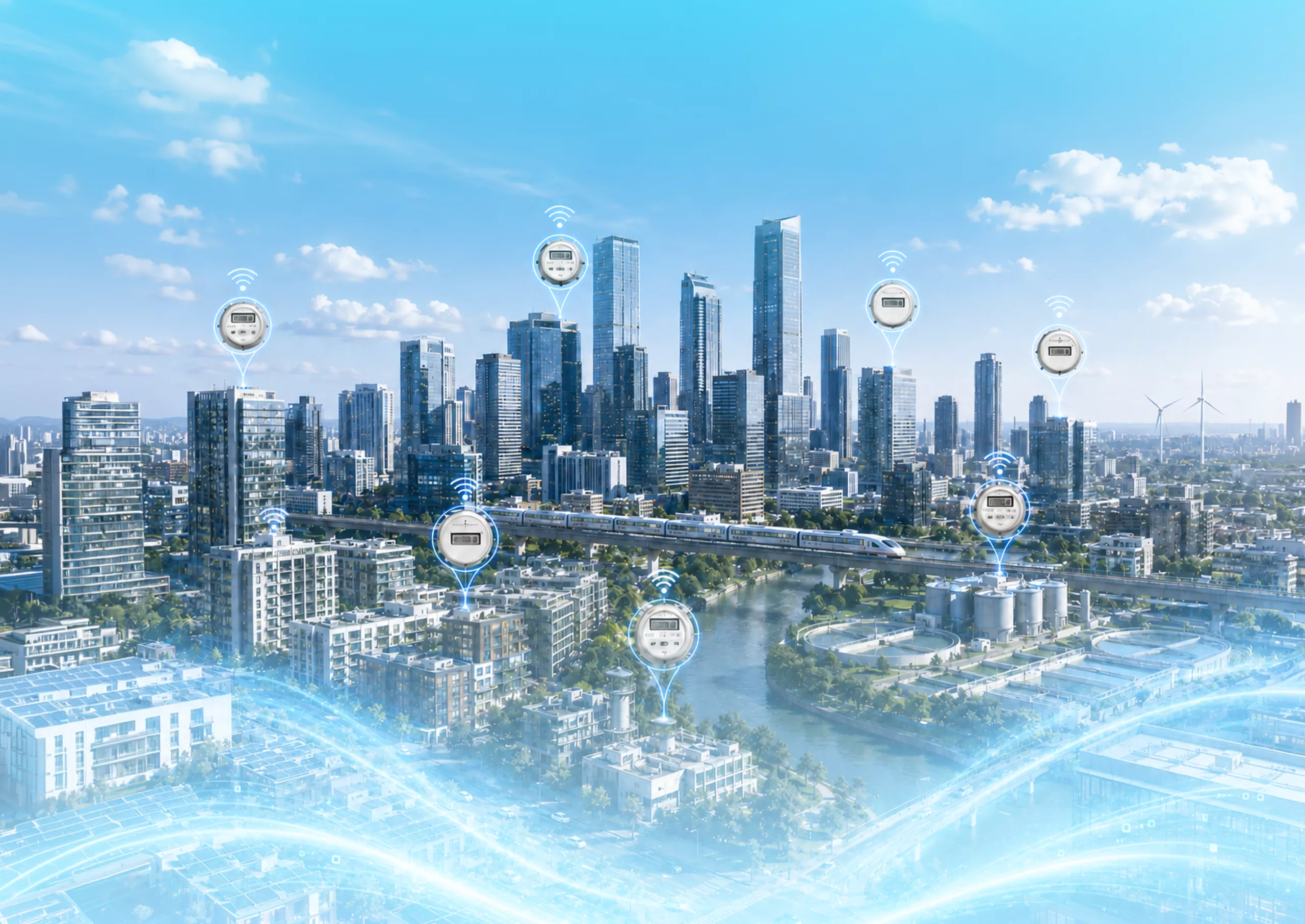
Every utility depends on accurate consumption data. Water, gas, electricity, and district-energy providers must determine how much each customer uses so they can issue bills, monitor demand, detect problems, and plan infrastructure.
For a small utility, collecting this information may be manageable. For a large city, however, hundreds of thousands of meters may be spread across homes, commercial buildings, industrial facilities, underground pits, mechanical rooms, and remote sites.
Utilities generally use one of two metering architectures:
- Automated Meter Reading, or AMR
- Advanced Metering Infrastructure, or AMI
Both reduce the need to inspect meters manually. The main difference is how the data reaches the utility.
AMR still requires an employee or vehicle to travel near the meter. AMI uses a permanently deployed communications network to automatically collect data.
For small or low-density utilities, AMR can be an economical first step away from manual reading. For a large city managing hundreds of thousands of meters, AMI usually offers greater long-term operational and financial value.
TEKTELIC’s LoRaWAN® gateways and sensors for smart metering provide practical building blocks for AMI, helping utilities connect meters, detect leaks, improve coverage, and move data from buildings and neighborhoods into central applications.
What Is Smart Metering?
Smart metering uses electronic devices to measure and record the consumption of resources such as:
- Electricity
- Gas
- Water
- District heating and cooling
- Other metered utilities
Traditional meters may be read only once a month. Smart meters can collect data more frequently and communicate it electronically.
This enables more accurate billing, better demand management, earlier identification of abnormal consumption, and greater awareness of usage patterns.
Depending on the system, smart meters may also support two-way communication. Utilities can use this capability for remote configuration, outage detection, load control, pricing programs, and customer notifications.
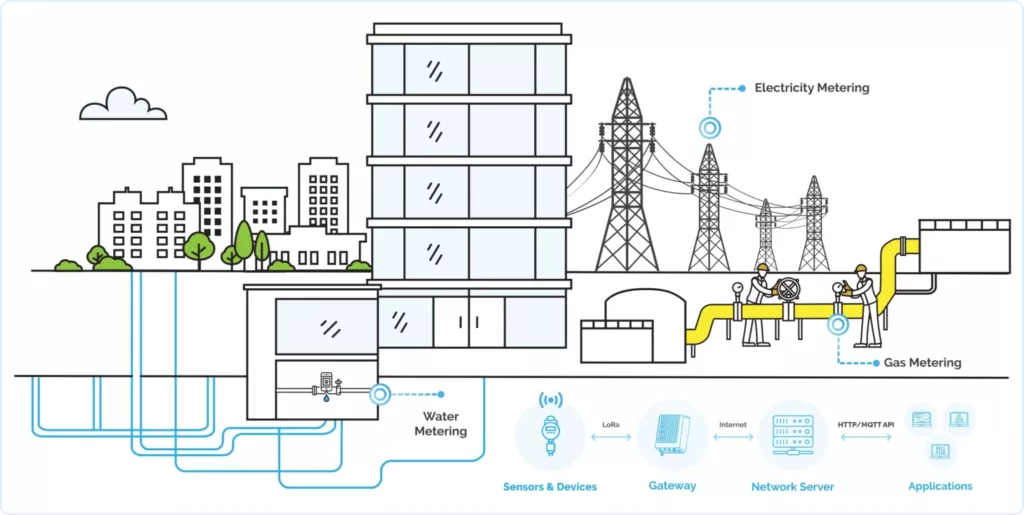
Smart metering, therefore, changes the purpose of meter data. Instead of supporting billing alone, the information can also support operations, conservation, customer service, and infrastructure planning.
AMR: Automating the Reading, Not the Route
Automated Meter Reading is generally a one-way communications system.
Each meter is fitted with a radio module. A utility employee drives or walks through the service area with a mobile receiver. When the receiver comes within range, it collects information such as:
- Meter identification
- Accumulated consumption
- Meter status
- Limited alarm information
The data is stored in a handheld or vehicle-mounted system and later transferred to the utility’s billing or meter-data platform. Some systems upload data continuously through cellular connectivity, while others upload it after the route is completed.
A typical AMR system includes a meter, radio module, mobile receiver, route-management software, and billing-system interface.
Compared with manual reading, AMR improves efficiency and safety. Employees no longer need to enter every property or inspect every meter register.
However, the vehicle still has to make the trip.
That is AMR’s defining limitation: it automates the meter reading but does not eliminate the meter-reading route.
AMR may be suitable when the utility is small, meter density is low, readings are required only monthly, existing meters can be upgraded, or capital funding for a fixed network is limited. It can also be useful as a temporary step toward AMI.
However, recurring labour and vehicle costs remain. Missed transmissions may require another visit, and weather, traffic, road conditions, or access restrictions can disrupt collection.
Sparse data also limits what the utility can see. A leak that begins immediately after the monthly reading may continue for weeks before appearing on the next bill. Intermittent leaks, unusual nighttime use, reverse flow, and sudden consumption changes can also be difficult to identify.
AMI: A Permanently Connected Metering Network
Advanced Metering Infrastructure uses a fixed communications network to connect meters with the utility.
Instead of waiting for a collection vehicle, smart meters transmit data automatically to gateways or collectors. The gateways forward the information through cellular, Ethernet, fibre, or another backhaul connection to the utility’s network server and applications.
An AMI system typically includes:
- Smart meters or meter-interface devices
- Radio communication modules
- Fixed gateways
- Backhaul connectivity
- Network-management software
- Meter-data-management systems
- Billing, analytics, and customer-service applications
For battery-powered water and gas meters, the radio does not need to remain continuously active. A meter can measure consumption frequently, store the information, and transmit compact messages at scheduled intervals.
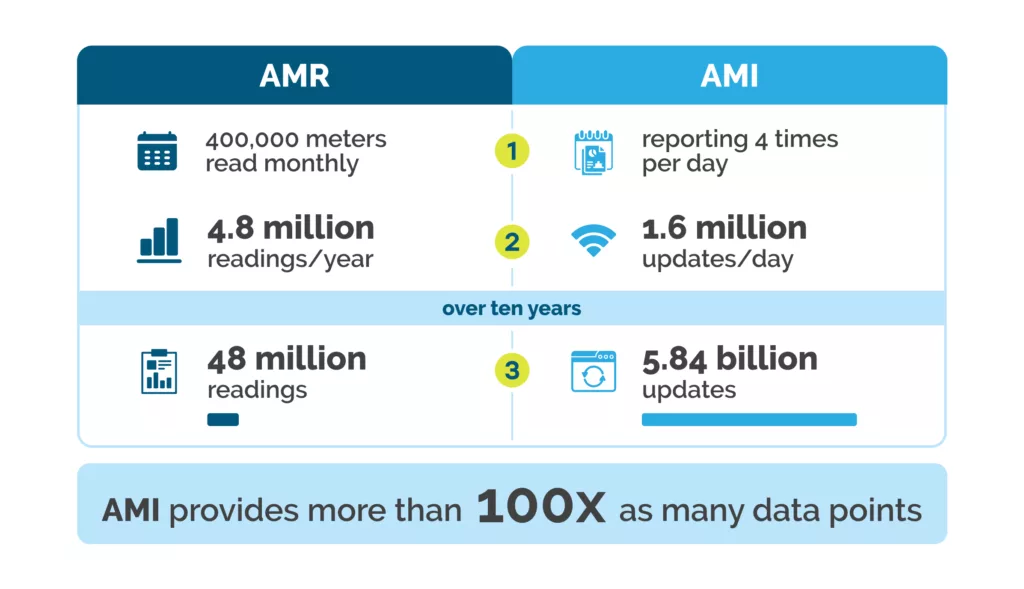
For example, a water meter might report four times per day instead of once per month.
This transforms meter data from a periodic billing input into a source of timely operational intelligence.
How TEKTELIC Smart Metering Works
A smart metering deployment can use LoRaWAN® technology to connect meters and sensors across residential buildings, commercial properties, manufacturing facilities, or an entire city.
The process has four main stages.
First, smart meters and sensors collect information. This may include water, gas, electricity, or thermal-energy consumption, as well as moisture, air quality, temperature, carbon dioxide, occupancy, lighting, or equipment status.
Second, LoRaWAN® devices transmit compact radio messages. This technology is designed for long-range, low-power communications and is well suited to devices that send relatively small amounts of data.
Third, TEKTELIC gateways receive the messages and securely forward them to the network server. More than one gateway may receive the same transmission, improving coverage and network reliability.
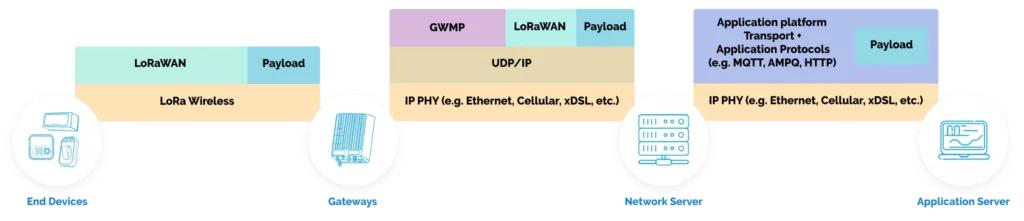
Finally, the network server sends the information to utility or customer applications. Users can view consumption history, alarms, usage trends, meter status, district demand, and reports on computers or mobile devices.
The value of AMI therefore depends not only on collecting data, but also on converting it into useful information.
COMFORT v2: Combining Meter Reading and Leak Detection
Consumption data can suggest that a leak is occurring, but a dedicated sensor can provide more direct evidence.
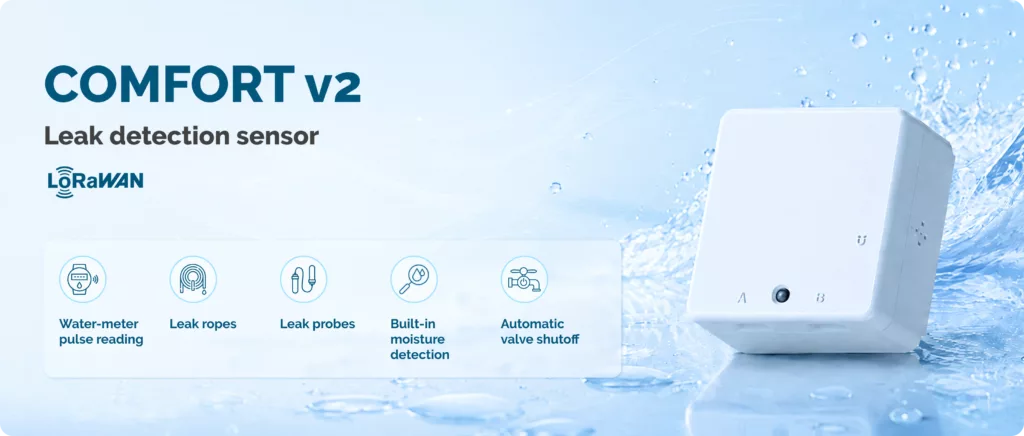
This makes COMFORT v2 useful in mechanical rooms, apartment buildings, commercial properties, manufacturing facilities, boiler rooms, residential basements, and other locations where water damage is a concern.
A pulse input can collect readings from a compatible water meter. Leak ropes or probes can be installed near pipes, tanks, pumps, valves, or water-sensitive equipment.
When abnormal moisture is detected, the system can generate an alert. Where automatic shutoff equipment is installed, the response can extend beyond notification by helping isolate the water supply.
This demonstrates an important advantage of AMI: the network can do more than collect billing data. It can also connect devices that reduce water waste, limit property damage, and support faster response.
What AMI Enables Beyond Billing
A properly designed AMI network can support:
- Several meter updates per day
- Continuous-flow detection
- Leak and moisture alarms
- Reverse-flow warnings
- Tamper alerts
- Timely billing
- Move-in and move-out readings without field visits
- Customer usage portals
- High-consumption notifications
- Demand forecasting
- District-level consumption analysis
- Non-revenue-water programs
- Remote configuration where supported
- Pressure, flow, and water-quality sensors
- Smart-building environmental monitoring
- Improved work-order and asset management
The same network can begin with water meters and later support gas meters, environmental sensors, pressure monitors, leak detectors, or other LoRaWAN® devices.
AMI therefore becomes a shared digital platform rather than a single-purpose meter-reading system.
AMR and AMI Compared
| Consideration | Drive-By AMR | Fixed-Network AMI |
| Collection method | Vehicle or handheld receiver | Permanent gateway network |
| Data availability | Monthly or route-based | Several times per day or more |
| Routine vehicles | Required | Normally unnecessary |
| Reading labour | Relatively high | Relatively low |
| Initial network investment | Lower | Higher |
| Leak identification | Often delayed | Potentially within hours |
| Missed readings | May require another visit | Can often be received again |
| Customer portals | Limited | Readily supported |
| Indoor coverage | Depends on passing receiver | Can use gateways such as KONA Micro |
| Additional sensors | Limited | Can include devices such as COMFORT v2 |
| Operational analytics | Limited | Supported by frequent data |
| Scalability | More meters increase routes | New devices can often use the existing network |
A Large-City Cost Example
Consider an illustrative city with:
- 850 square kilometres of territory
- 1.4 million residents
- 400,000 water meters
- Monthly AMR collection
- A 12-person reading team
- A loaded labour rate of $90 per hour
- 150 KONA Macro gateways
- Four meter updates per day
- A ten-year evaluation period
Assume the AMR team works 2,080 hours per person annually.
Annual AMR labour cost is:
12 × 2,080 × $90 = $2,246,400
Over ten years:
$22,464,000
This equals $56.16 per meter over ten years.
The estimate includes labour only. Vehicles, fuel, insurance, maintenance, route software, supervision, overtime, and repeat visits would increase the actual AMR cost.
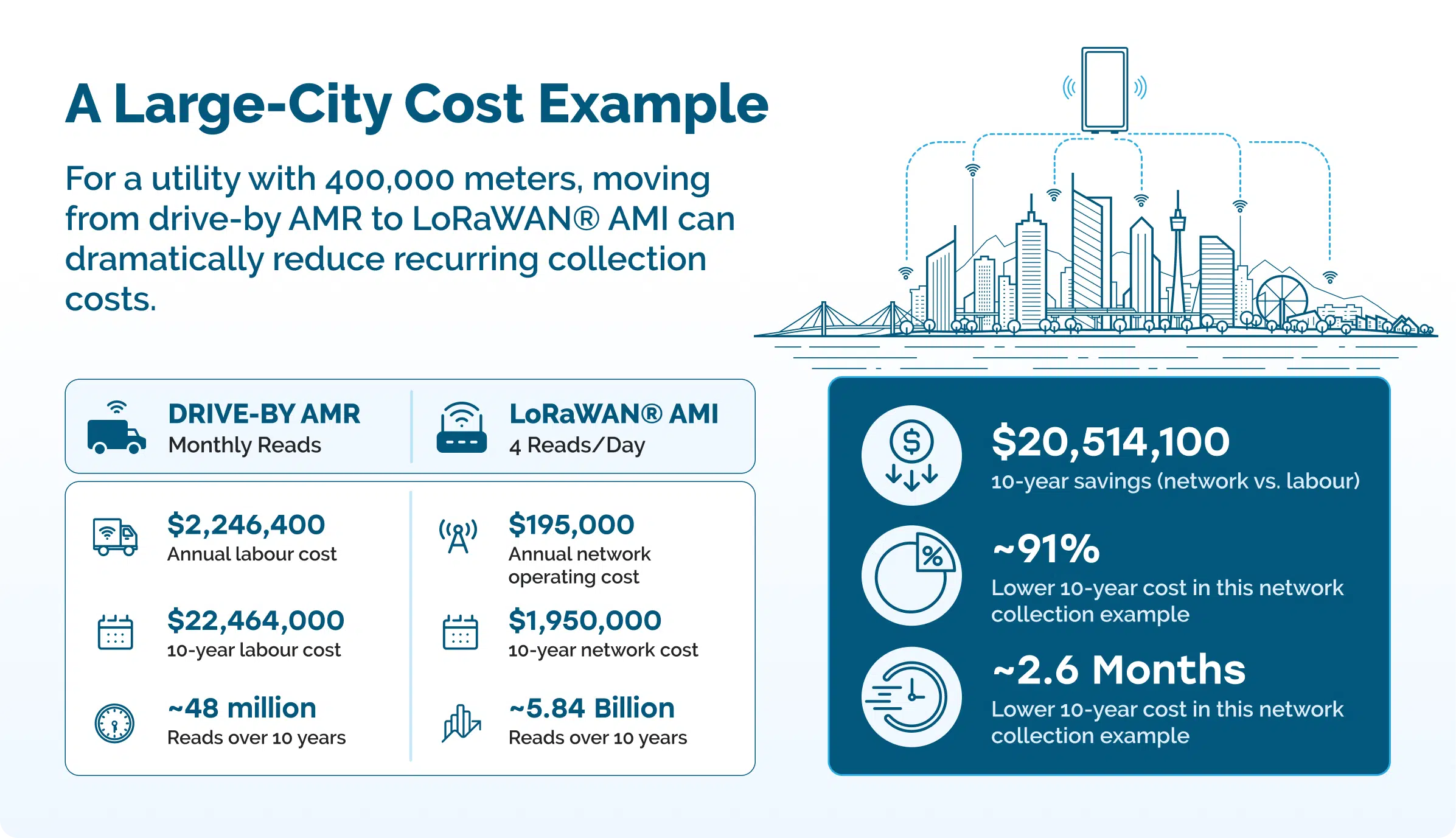
For AMI, assume each gateway costs $1,000, installation costs $2,000, and annual operation costs $1,000.
The initial installed cost of 150 gateways is:
150 × $3,000 = $450,000
Ten-year gateway operation is:
150 × $1,000 × 10 = $1,500,000
Total ten-year AMI network cost is:
$1,950,000
This equals approximately $4.88 per meter over ten years.
Under these assumptions:
- AMR labour: $22.464 million
- AMI gateway network: $1.95 million
- Estimated difference: $20.514 million
The modeled AMI network costs approximately 91 percent less than the AMR labour model.
The annual operating difference is about $2.1 million. On a network-only basis, the initial $450,000 gateway investment would be recovered through avoided labour in approximately 2.6 months.
This is not a complete AMI project payback calculation. It excludes meters, endpoints, software, backhaul, cybersecurity, integration, data storage, customer portals, and other project costs.
More Data at a Lower Collection Cost
Frequent data can reveal continuous consumption, intermittent leaks, nighttime use, sudden demand changes, reverse flow, and possible tampering.
When meter information is combined with COMFORT v2 leak detection, the utility gains both consumption-based evidence and direct moisture detection.
Costs and Engineering Requirements
A full business case must include costs omitted from the simplified comparison.
Potential AMR costs include vehicles, fuel, maintenance, insurance, mobile receivers, route software, supervision, safety, and repeat visits.
Potential AMI costs include smart meters, radio endpoints, COMFORT v2 sensors, KONA gateways, network-server software, meter-data-management platforms, cellular backhaul, cloud services, cybersecurity, integration, spare units, batteries, customer portals, and valve-shutoff equipment.
Network design is equally important.
The large-city example averages about 2,667 meters per gateway, but averages do not prove coverage or capacity.
The final design must consider underground meters, building materials, terrain, antenna height, interference, packet size, spreading factors, retransmissions, gateway overlap, backhaul availability, and delivery requirements.
RF modelling, site surveys, pilot deployments, and representative field testing should therefore be completed before city-wide implementation.
Long-Term AMI Performance Starts with the Right Gateway
Selecting AMI is only part of the decision. Utilities also need gateways suited to their coverage, capacity, environment, and maintenance requirements.
For large outdoor LoRaWAN® networks, TEKTELIC’s KONA Macro and KONA Mega provide carrier-grade reliability, remote monitoring and management, and robust hardware designed for long operational life. Their durability can reduce site visits, maintenance work, and premature gateway replacements.
This matters because utilities expect infrastructure to operate reliably for 10 years or more. By deploying gateways that are built for continuous service and can be managed remotely, utilities can lower total cost of ownership and avoid repeated field interventions.
TEKTELIC’s experience with large-scale LoRaWAN® deployments helps utilities select and operate gateway infrastructure that matches their specific network requirements—not simply install more hardware.
Summing Up
The choice between AMR and AMI is not really a choice between two meter-reading methods. It is about collecting readings and operating a connected network.
AMR automates the reading. A radio module replaces the visual inspection, and a route that once took days can be completed in hours. The route itself, however, remains. Vehicles, fuel, staff time, and repeat visits stay on the books, and the data arrives only as often as the vehicle passes.
AMI removes the route. Fixed gateways collect data continuously, which changes both the economics and the usefulness of the information.
And TEKTELIC can power up and set up your smart metering system. For a detailed inquiry, contact us and we’ll make your utility managemant smarter.