Articles
5 min reading
19 August 2026
19 August 2026
Post-Discharge Home Recovery: How Remote Monitoring Closes the Visibility Gap


A patient is discharged on Tuesday. The care team next contacts them by phone on Friday, with a clinic appointment scheduled two weeks later.
What happens between those touchpoints?
Recovery continues at home, but care teams may have limited objective information about how it is progressing. Follow-up calls, home visits, clinic appointments, and patient-reported symptoms remain essential, but each provides only a snapshot.
This is the core challenge of post-discharge care: recovery is continuous, while traditional follow-up is episodic.
Remote patient monitoring (RPM) can help close this visibility gap. It extends objective information beyond discharge, helping care teams understand recovery trends and identify patients who may benefit from earlier or additional attention.
The goal is not to replace patient communication, scheduled follow-up, or clinical judgment. It is to give care teams another layer of information between interactions.
The window where recovery is decided
Most post-discharge programs rely on scheduled touchpoints: a call at 48 or 72 hours, a home visit if needed, and a clinic appointment at two or four weeks. Each provides valuable information. But between these interactions, clinicians depend on the patient or caregiver to notice and report any changes.
This creates several challenges.
Changes can develop between scheduled interactions
Oxygenation may decline, respiration rate may increase, skin temperature may rise slightly, and activity level may decrease. These changes can persist for days before the patient notices symptoms worth reporting.
- Patients often under-report symptoms
Recently discharged individuals may be fatigued, medicated, concerned about being a burden, or uncertain about what is normal in their recovery. As a result, responses to “How are you feeling?” are often unreliable, even when asked appropriately.
- A single measurement rarely tells the whole story
Patients have different baselines and different recovery trajectories. For example, a resting pulse of 92 may be normal for one patient but significant for another. Without knowledge of a patient’s baseline, a single reading is difficult to interpret.
By the time a patient contacts the clinic or visits the emergency department, the underlying change has often occurred several days earlier. The key clinical question is not what happened, but why it was not detected sooner.
- The uniform-follow-up trap
Without a way to identify at-risk patients, care teams treat all discharged patients the same. Each patient receives follow-up calls at standard intervals.
Some patients may be recovering as expected. Others may benefit from earlier outreach, additional assessment, or closer follow-up.
Uniform follow-up over-serves stable patients and under-serves those at risk. Limited clinical capacity means time spent on stable patients reduces attention for those showing early signs of deterioration.
The goal of post-discharge monitoring is not increased contact, but targeted contact, reallocating clinical attention to patients who need it most.
For hospitals, virtual care teams, and home care providers managing large patient populations, this can help make better use of limited clinical capacity.
Monitoring does not make the decision for the clinician. It provides additional information to support that decision.
The adherence tax
A common reason remote-monitoring pilots fail is patient disengagement, even when the program itself is effective.
Depending on the monitoring architecture, patients may be required to:
- Own a compatible smartphone
- Pair a device over Bluetooth
- Keep the app installed and logged in
- Keep the phone charged and nearby
- Charge the wearable, often nightly
- Take a manual reading at a set time
- Enter or confirm the result
A program becomes harder to sustain when patients must manage multiple steps on their own. These requirements may be particularly challenging for older adults, those recovering from major surgery, individuals with cognitive or dexterity challenges, and those lacking reliable broadband or a smartphone.
As a result, programs that depend on complex digital routines may be less accessible to some patients who could benefit from additional post-discharge visibility. This leads to a simple design principle: reduce the number of actions required from the patient wherever possible. Low-power sensors with multi-month battery life can minimize battery maintenance, while automated data transmission reduces manual steps. Instead of relying on a patient’s smartphone, Bluetooth pairing, or home Wi-Fi, a preconfigured LoRaWAN gateway can provide a dedicated connection between the monitoring device and the remote monitoring platform. Together, these choices reduce potential failure points and support more consistent data continuity throughout the recovery period.
What is actually worth measuring
The objective of remote monitoring is not to collect more data. More information can create more work if nobody knows what to do with it. Instead, healthcare organizations should ask which measurements can meaningfully support decisions within a defined recovery pathway.
Physiological trends
Depending on the patient population and selected device, relevant measurements may include:
- oxygen saturation (SpO₂)
- respiration rate
- pulse rate
- skin temperature
Their value comes from providing objective information that professionals can review alongside historical trends, patient-reported symptoms, and other relevant clinical context.
Individual measurements should not be interpreted in isolation, and the monitoring technology should not determine clinical thresholds or interventions. Those decisions belong to the healthcare provider.
Contextual signals
Physiological measurements may not tell the entire recovery story. Activity level and body position provide insights that physiological readings cannot, such as whether a patient is maintaining normal routines or spending more time in bed. Room presence, movement patterns, and door activity further illustrate daily function and routine, offering valuable context beyond physiological data.
Patient-reported input
Objective measurements should supplement, but do not replace, symptom reporting and patient communication. Symptoms, concerns, and other information reported by patients and caregivers remain important. Where appropriate, a call-for-help button can also provide a direct way for a patient to request assistance.
The key criterion for any measurement is its impact on care: if a change in value would not alter clinical actions, it should not be included in the program.
Designing a program that survives contact with reality
The success of a post-discharge monitoring program depends on more than selecting a wearable. Several decisions should be made before the first patient is enrolled.
1. Select a specific pathway
Instead of targeting all post-surgical patients, focus on one procedure, one population, and one recovery trajectory. Broad programs produce generalized data without actionable conclusions.
2. Establish escalation protocols before deployment
Pilots often stall when data arrives without a designated reviewer. Define who reviews the data, how frequently, the thresholds for action, and the specific steps to take when thresholds are crossed. Vague plans, such as ‘the care team will look at it,’ are insufficient.
3. Define what information matters for the individual pathway
Population-wide measurements can provide useful context, but clinical interpretation must account for the individual patient and recovery pathway. Rather than allowing the technology to dictate what constitutes an alert, providers should define appropriate review criteria within their own clinical protocols. This can also help avoid unnecessary information and focus professional attention on meaningful changes.
4. Track program economics from the outset
The key metric is total cost per monitored patient, including devices, connectivity, clinician review time, onboarding, and support compared to changes in emergency visits, 30-day readmissions, inpatient days, and follow-up workload. This gives healthcare organizations a much stronger basis for determining whether broader deployment is justified.
5. Define a clear endpoint for each monitored patient
Post-discharge monitoring should have a defined purpose and duration. The appropriate monitoring period will depend on the patient population, recovery pathway, and provider’s clinical protocols. Clear completion criteria also help organizations manage review capacity and plan for new patients entering the program.

What monitoring can and cannot claim
Transparency is important, as this category faces credibility challenges due to past overstatements. Remote monitoring alone does not reduce readmissions. However, effective workflows do.
Monitoring provides information, but reductions occur only when clinicians act on this information promptly. Programs that generate quality data without the capacity for timely intervention often see no improvement in outcomes.
Not all readmissions can be prevented. Many result from disease progression, unavoidable complications, or necessary clinical escalation. The truly addressable cases are those where earlier detection could have enabled timely intervention. This group is real, but smaller than headline figures suggest.
Despite this, the financial impact remains significant, and regulatory pressure is increasing. For fiscal year 2026, CMS placed 240 hospitals, or 8.1 percent of those in the Hospital Readmissions Reduction Program, in the penalty band of 1 percent or more, up from 208 the previous year. This marks the first increase after five years of decline. About 70 percent of hospitals face penalties below 1 percent, 22 percent avoid penalties entirely, and the statutory maximum remains 3 percent of Medicare inpatient reimbursement.
Measurement standards are also becoming stricter. Under the FY 2026 inpatient payment rule, CMS will include Medicare Advantage beneficiaries in readmission cohorts and shorten the performance window from three years to two.
A second key finding is that, according to a 2025 Vizient analysis of Medicare fee-for-service claims, over a quarter of readmissions occur at a different hospital than the original admission. These readmissions cost about 5 percent more, averaging $1,372 extra per case and totaling approximately $21 billion annually. Fragmentation is more severe for rural patients and is significantly worse in the most socially vulnerable neighborhoods.
This has direct implications for post-discharge programs. Hospitals that review only their own records underestimate patient outcomes, as many discharged patients are readmitted elsewhere. The visibility gap is not just about the immediate post-discharge period; it is a gap in understanding overall outcomes. Monitoring that tracks patients, rather than facilities, is one of the few ways to address this issue.
However, these factors do not make a monitoring program self-justifying. Comparisons must still be made against the provider’s own baseline, not sector averages. Still, with more hospitals penalized, a broader measured population, a shorter performance window, and a significant portion of readmissions currently untracked, the cost of limited visibility is increasing.
A defensible position is that monitoring extends visibility, visibility enables prioritization, and prioritization drives clinical and financial results. Each step in this process must be developed intentionally.
The TEKTELIC Approach to Post-Discharge Monitoring
TEKTELIC’s Remote Patient Monitoring solution is designed to provide objective information from the home while minimizing the technology patients need to manage.
The architecture combines wearable monitoring devices, LoRaWAN® connectivity, a preconfigured home gateway, and professional review tools.
No patient smartphone required
Physiological measurements are transmitted from the wearable over LoRaWAN® to a preconfigured KONA Micro Gateway in the patient’s home. The gateway forwards the information to the TEKTELIC application environment, where authorized professionals can review current information and historical trends.
Patients are not required to own, pair, charge, or operate a smartphone. No app installation, Bluetooth connection, or manual reading is required. LoRaWAN’s long-range, low-power capabilities allow the wearable to transmit data as the patient moves throughout the home, without the need to remain near a phone or hub.
Depending on the deployment configuration, the KONA Micro Gateway can use cellular backhaul, reducing dependence on the patient’s home broadband. Battery backup can also help maintain connectivity during short power interruptions.
Two wearables, matched to the pathway
Different recovery pathways require different information.
TEKTELIC offers two primary wearable options for physiological monitoring.
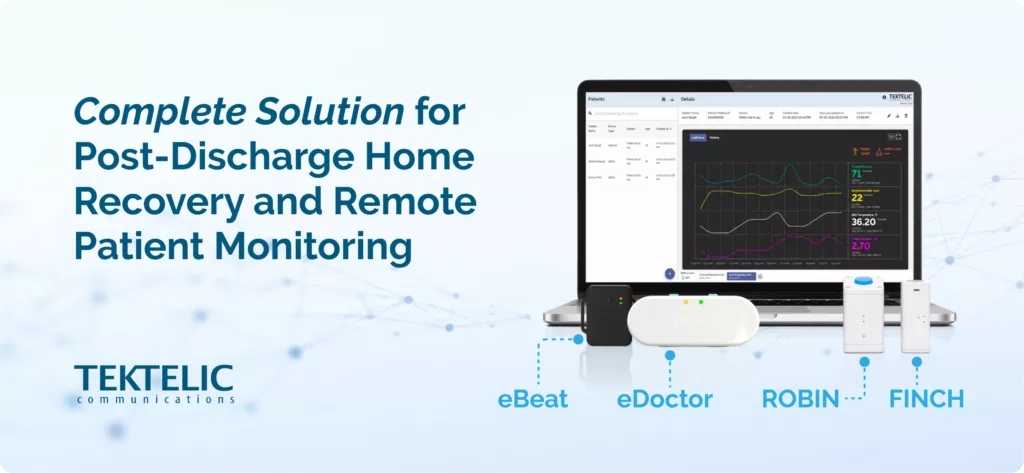
- eBeat is an arm-worn device that provides intermittent SpO₂, respiration rate, pulse rate, and skin-temperature measurements.Its 3+ month battery life reduces the need for frequent battery maintenance during the monitoring period.
- eDoctor is a chest-worn device that provides intermittent respiration rate, pulse rate, and skin-temperature measurements.It can also provide activity-level and body-position information, adding recovery context alongside physiological trends.
With 4+ months of battery life, eDoctor can support extended monitoring without frequent battery maintenance. It can be considered for cardiovascular and broader recovery pathways where physiological, activity, and posture information are reviewed together.
The appropriate wearable should be selected according to the patient population, monitoring objectives, and the healthcare provider’s defined workflow.
Beyond vital signs: adding recovery and safety context
Where the pathway justifies it, additional LoRaWAN devices can extend the picture beyond physiological measurements:
- FINCH — a wearable call-for-help button, giving the patient a direct channel to request assistance
- VIVID v3 — passive presence, movement, temperature, humidity, and light monitoring, adding context on room use and activity patterns
- COMFORT v2— door open/close, temperature, humidity, and light monitoring, adding context on entry and exit patterns and daily routine
These additional sensors are optional. eBeat and eDoctor are the primary physiological devices, while the others should be used only when they address specific clinical questions.
The recovery journey, end-to-end
A TEKTELIC-enabled post-discharge monitoring program can follow a straightforward workflow.
- Discharge — a suitable patient receives the selected wearable for a defined recovery period
- Recover at home — the device collects intermittent physiological and recovery-context measurements.
- Connect automatically — the preconfigured KONA Micro Gateway transmits data over LoRaWAN®.
- Review trends — authorized professionals review current readings and historical trends.
- Prioritize follow-up — care teams focus attention on the patients who may need earlier outreach
While the technology supports the process, the healthcare provider remains responsible for clinical interpretation and decisions.

Who it is built for
This solution is intended for hospitals, health systems, post-acute and virtual care programs, home-care services, and elderly care facilities, any setting where care teams require objective visibility between scheduled interactions without increasing in-person visits or requiring patients to manage technology.
It is designed to supplement scheduled follow-up, patient self-reporting, and clinical judgment. The solution does not replace these elements or guarantee reduced utilization. Instead, it provides information to support earlier, more evidence-based follow-up decisions than scheduled phone calls alone can.
Closing the post-discharge visibility gap
The transition from hospital to home should not have to mean losing visibility into recovery.
Remote monitoring can extend objective information beyond discharge while allowing patients to recover in familiar surroundings. But successful programs require more than connected devices. They need the right measurements, low-friction patient participation, reliable connectivity, defined clinical ownership, clear workflows, and measurable objectives.
This is where LoRaWAN can provide an important foundation.
By combining low-power wearable devices with long-range connectivity and a dedicated home gateway, healthcare organizations can reduce dependence on patient-managed smartphones and build a monitoring architecture designed for practical deployment at home.
And that leads back to the central principle:
The goal is not to monitor every patient more. It is to give care teams better visibility so they can focus on what matters most.