Expertise
5 min reading
7 May 2026
7 May 2026
How LoRaWAN Is Transforming Commercial HVAC Filter Maintenance

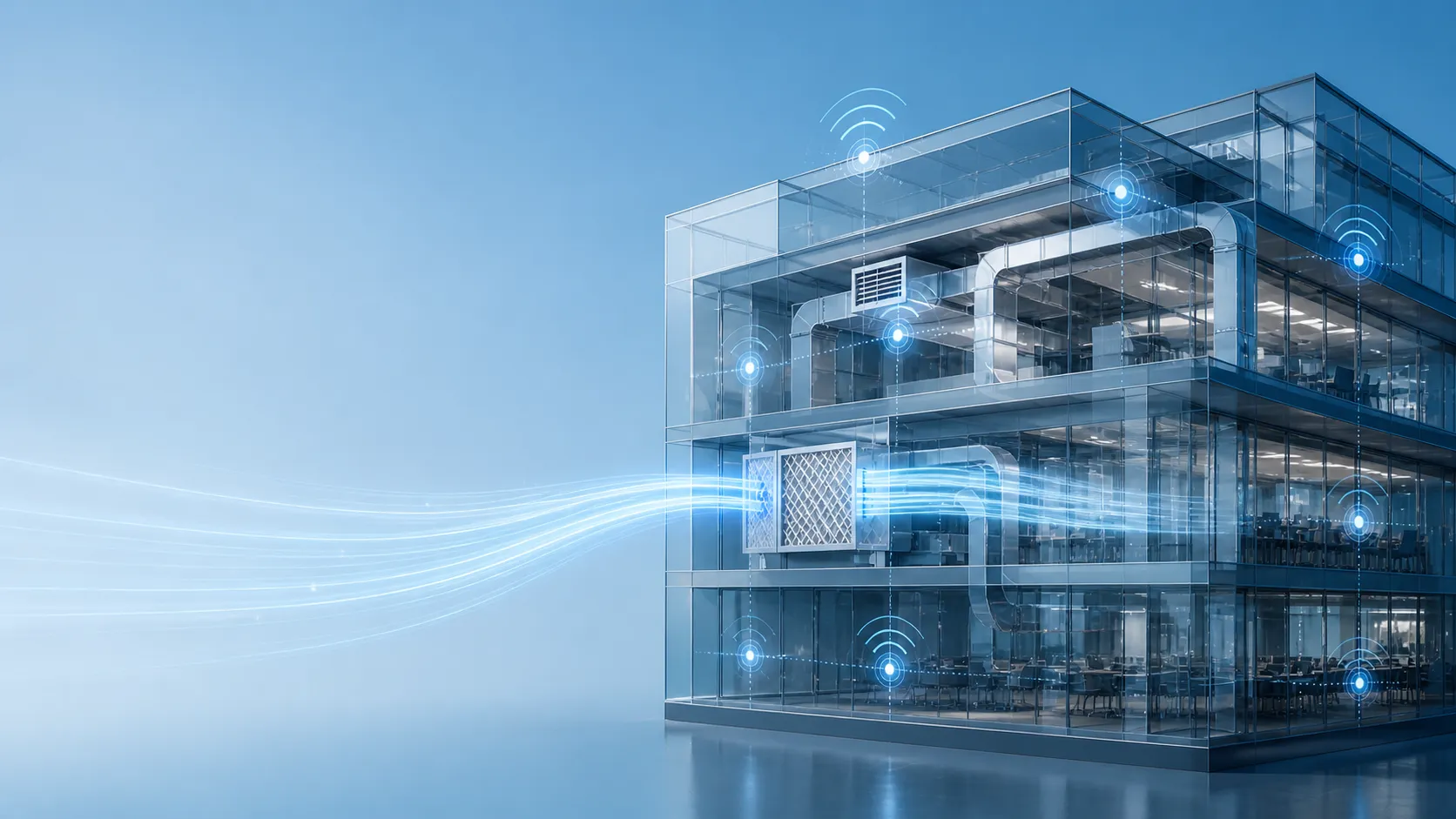
When was the last time anyone on your team actually checked the HVAC filters across all of your buildings? If the honest answer is ‘we follow a fixed schedule’ — you’re probably replacing some filters too early and leaving others in service far too long.
Most commercial facility managers already know that HVAC filter maintenance matters. What’s harder to solve is making it practical at scale — across dozens, hundreds, or even thousands of buildings spread across a city, a country, or an entire continent. Sending technicians on scheduled rounds is expensive, slow, and imprecise. Ignoring the problem costs even more: degraded indoor air quality, rising energy bills, early equipment failures, and tenant complaints.
There is now a better way. LoRaWAN-based differential pressure monitoring makes it possible to know the real condition of every HVAC filter in every building — continuously, remotely, and at a cost that makes sense even at massive deployment scale.
This article explores how this technology works, what it delivers in practice, and why TEKTELIC’s end-to-end LoRaWAN solution is built precisely for this kind of challenge.
The Hidden Cost of “Good Enough” Filter Maintenance
HVAC filters sit at the intersection of indoor air quality, energy efficiency, and equipment longevity. A clean, properly installed filter does a remarkable amount of work: it reduces particulate matter (PM1.0, PM2.5, and PM10), supports proper airflow and ventilation, contributes to CO₂ management, and protects the coils, fans, motors, and compressors that keep your system running.
So what happens when that filter gets dirty — or goes unchecked for too long?
- Airflow resistance increases, forcing fans to work harder and raising energy consumption
- Filtration efficiency drops, allowing particulate matter to circulate through occupied spaces
- Coils and heat exchangers become fouled, reducing system efficiency and increasing maintenance costs
- Equipment runtime and mechanical stress increase, shortening system lifespan
- Tenant comfort declines — and complaints follow
Here’s what makes this problem tricky: filter degradation doesn’t follow a clean schedule. A filter in a high-traffic lobby might clog in weeks. The same model in a low-use stairwell might last a year. Fixed replacement schedules mean you’re almost always wrong — either wasting money on premature replacements or running with a filter that should have been swapped out long ago.
The answer isn’t a better schedule. The answer is real-time visibility into every filter’s actual condition.
What Differential Pressure Monitoring Actually Measures
The most reliable indicator of filter condition is differential pressure — the difference in air pressure between the upstream (dirty) side and downstream (clean) side of the filter. As the filter accumulates particulate matter and debris, airflow resistance increases and the pressure difference rises.
A clean filter shows a low, stable differential pressure. A filter approaching end of life shows elevated and rising pressure. An abnormally low reading — close to zero — can signal something equally serious: a missing filter, a bypass condition, a damaged filter, or an incorrectly installed one.
This single measurement unlocks a remarkable range of diagnostic capability. Beyond simple “dirty or clean” status, differential pressure trends over time can reveal:
- Filters that have been bypassed or installed incorrectly from day one
- Unusually rapid fouling that points to a maintenance or environmental problem upstream
- Damaged filters that appear installed but aren’t performing
- HVAC units with abnormal airflow patterns that may indicate a larger system issue
The challenge has always been getting this data reliably from every filter location — without running cables to every rooftop unit, mechanical room, and air handler across a large portfolio of buildings. That’s precisely where LoRaWAN changes the equation.
Why LoRaWAN Is the Right Wireless Technology for This Application
Not every IoT problem needs the same wireless technology. HVAC filter monitoring has specific characteristics that make LoRaWAN an exceptionally good match — and a poor fit for alternatives like Wi-Fi or cellular-per-sensor approaches.
Consider what the application actually requires: small data payloads (a pressure reading plus a timestamp), infrequent transmission (hourly, daily, or threshold-triggered), long battery life (devices are often installed where wiring is impractical), reliable indoor and rooftop coverage, and a cost structure that can scale to hundreds or thousands of sensors without becoming prohibitive.
LoRaWAN was designed for exactly this profile. Its key characteristics for this application are:
| Requirement | Why LoRaWAN Fits |
| Low data volume | Filter pressure readings are small packets — no bandwidth overhead needed |
| Long range | A single gateway can cover an entire commercial building or rooftop HVAC area |
| Strong RF penetration | 150 dB link budget penetrates walls, floors, metal enclosures, and mechanical rooms |
| Battery operation | TUNDRA devices can operate for many years — exceeding 8 years under nominal conditions |
| No wiring at each point | No Ethernet, Wi-Fi, or power runs required at every filter location |
| Large capacity per gateway | One gateway can support hundreds of monitoring points in the same building |
| Scalable architecture | The same approach works from one building to a nationwide portfolio |
Wi-Fi requires power and network infrastructure at every monitoring point — expensive and often impossible in older buildings or on rooftops. Cellular-per-sensor approaches generate per-device data costs that quickly become unmanageable at scale. Wired solutions require significant installation labor, especially in retrofits.
LoRaWAN eliminates all of these barriers. One gateway. Hundreds of sensors. Years of battery life. And the license-free spectrum means no carrier relationship required for the radio link itself.

The TEKTELIC Solution: From Sensor to Dashboard
TEKTELIC’s approach to HVAC filter differential pressure monitoring is built around a simple principle: use the best sensor for the job, connect it wirelessly, and deliver the data to whatever system the customer needs. Here is how the architecture flows in practice.
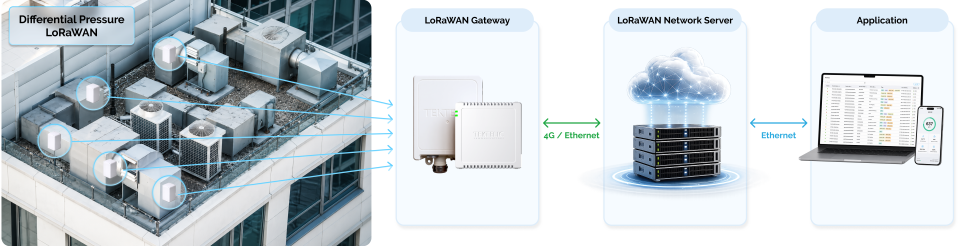
The TEKTELIC TUNDRA: Connecting Any Analog Sensor to LoRaWAN
Most commercial HVAC differential pressure transmitters — including widely-used models like the Dwyer 616KD-15 — provide standard analog outputs: either 4–20 mA current loops or 0–10 V voltage signals. These are proven, industrial-grade interfaces that HVAC engineers have trusted for decades.
The TEKTELIC TUNDRA device reads these analog signals directly and transmits the readings over LoRaWAN on whatever schedule makes sense for the application. This is important because it means customers can use the pressure transmitter they already trust — or specify — without being forced into a proprietary sensing solution.
The TUNDRA is built for the environments where HVAC equipment actually lives:
- IP67-rated enclosure — fully protected against dust and water ingress
- Operational range from -40°C to +60°C — suitable for rooftop and mechanical room installation
- Support for both 4–20 mA and 0–10 V analog inputs
- Battery life exceeding 8 years under nominal reporting conditions
- LoRaWAN Class A operation for reliable, low-power communication
Battery life deserves particular emphasis here. HVAC monitoring points are often in locations where adding power is expensive or disruptive — rooftop units, mechanical rooms in older buildings, remote air handlers. A device that runs for eight or more years on a battery transforms the installation from an electrical project into a simple mounting and wiring task that HVAC maintenance staff can handle directly.
The TEKTELIC Enterprise Gateway: Building-Wide LoRaWAN Coverage
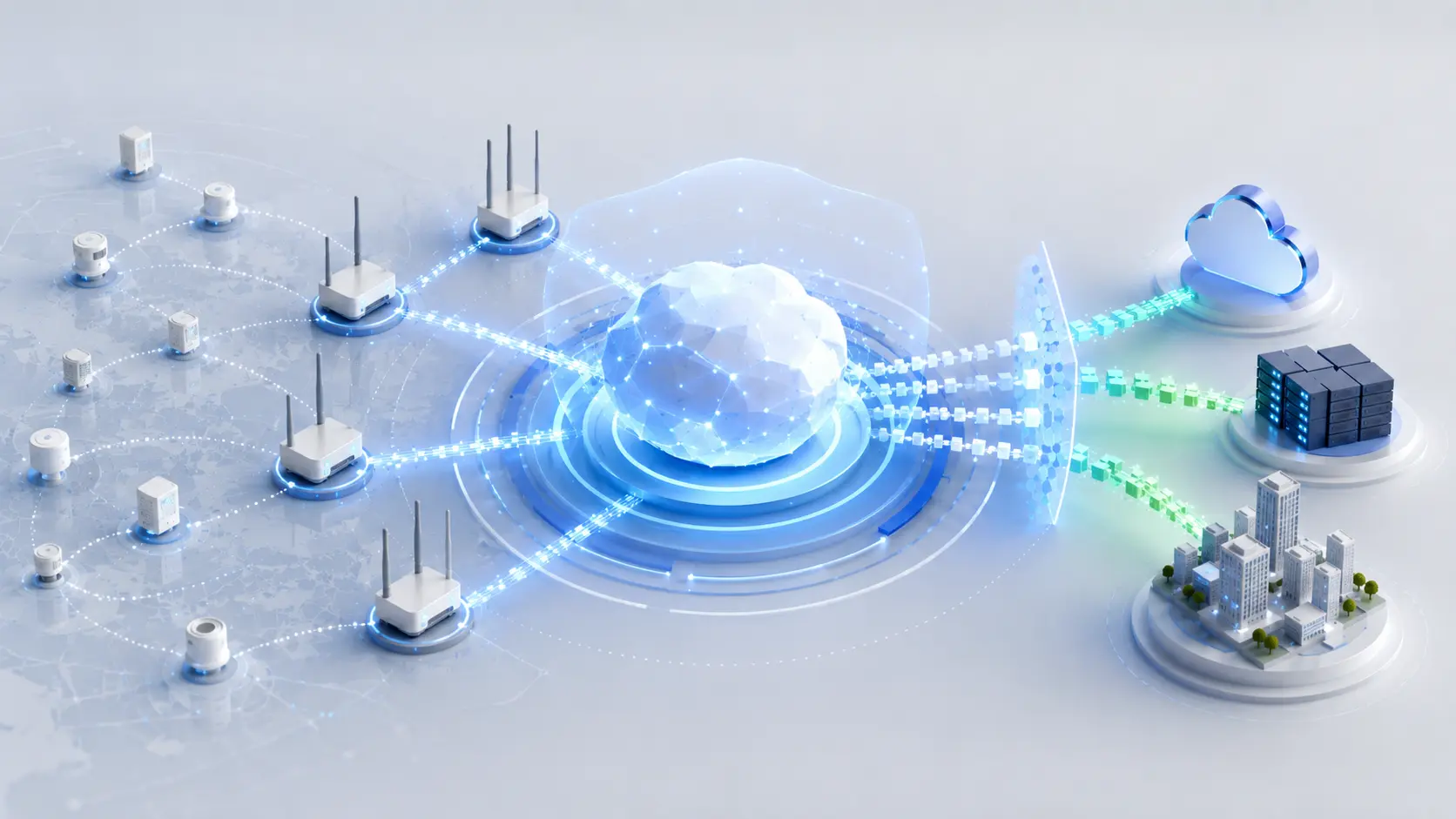
A single TEKTELIC Enterprise Gateway, installed on a rooftop or in a mechanical area, can provide LoRaWAN connectivity to hundreds of TUNDRA devices and other LoRaWAN sensors throughout the building. The gateway handles all radio communication and connects to the network server via Ethernet or cellular backhaul — whichever is more practical for the site.
For North American deployments in particular, the dual SIM capability is worth highlighting. The gateway can be provisioned with two cellular operators simultaneously, selecting the best based on coverage or cost at each specific location. In a nationwide deployment spanning many buildings across different geographies, this flexibility meaningfully reduces the risk of coverage gaps.
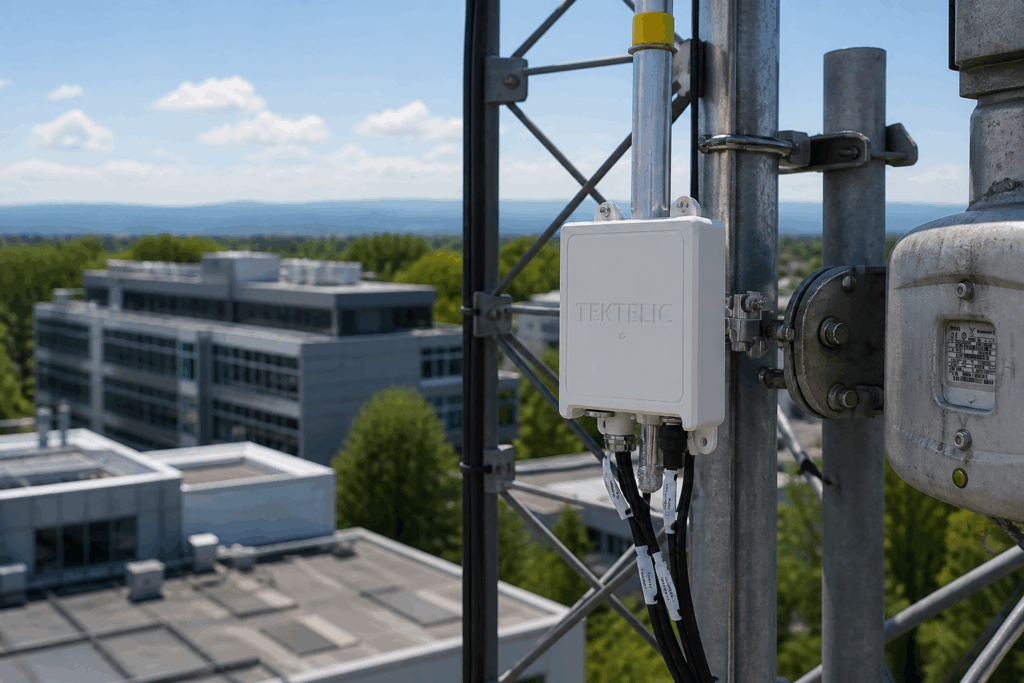
For more demanding environments — industrial facilities, large campuses, sites with significant electromagnetic interference from variable-frequency drives, compressors, or other power electronics — TEKTELIC’s Macro Gateway family provides enhanced RF performance, stronger filtering, and better interference rejection. The right gateway for each environment can be specified without changing the overall architecture.
| Deployment Environment | Recommended TEKTELIC Option |
| Standard commercial building | Enterprise Gateway |
| Rooftop HVAC units | Enterprise Gateway |
| Mechanical rooms | Enterprise or Macro Gateway depending on RF conditions |
| Industrial sites or high-interference zones | Macro Gateway |
| Smaller standalone systems | Gateway with embedded LNS |
Flexible Network Server Deployment
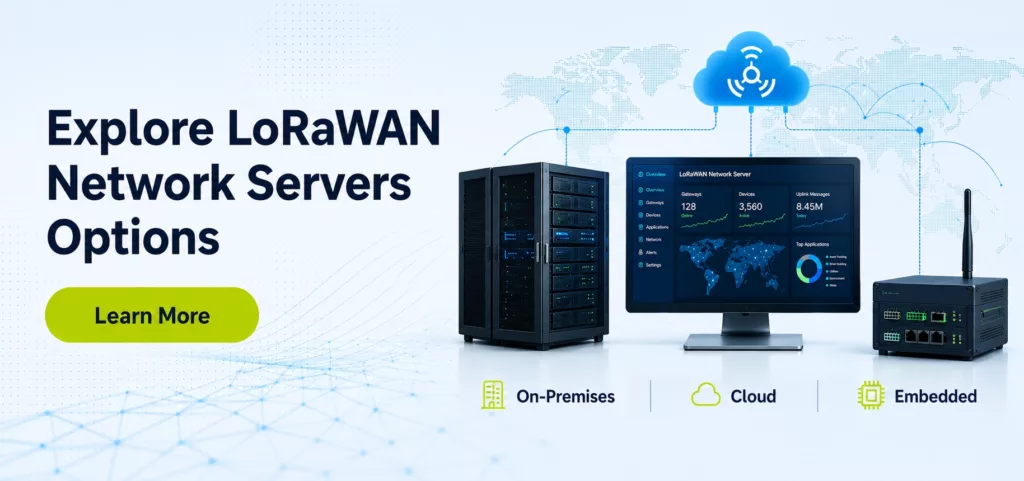
Data from the gateways flows to a LoRaWAN Network Server (LNS), which processes the radio packets and forwards the payload data to the application layer. TEKTELIC offers three deployment models for the LNS, and critically, all three use the same gateway and device portfolio:
- Cloud LNS — fast to deploy, easy to scale, no infrastructure to manage
- On-premises LNS — for customers that require data sovereignty, private infrastructure, or internal IT ownership
- Embedded LNS — for smaller buildings or standalone systems where the gateway manages LoRaWAN devices locally without a separate server
This flexibility matters more than it might initially appear. A large property management company may want cloud LNS for its commercial portfolio, on-premises LNS for a government or healthcare tenant with strict data requirements, and embedded LNS for smaller standalone properties — all operating as part of the same solution architecture. TEKTELIC supports all of these simultaneously.
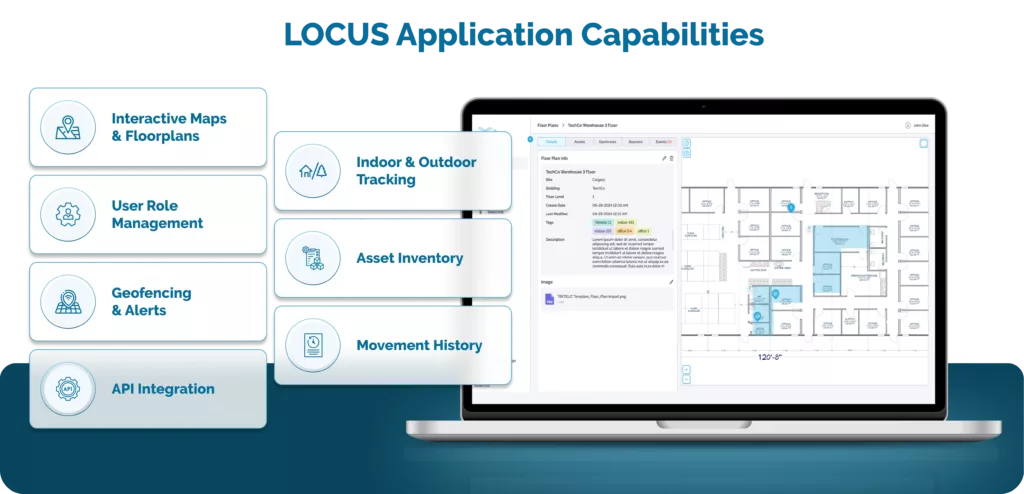
From Data to Action: The TEKTELIC LOCUS Application
Raw pressure readings become business value when they’re presented in context — with alarms, trends, maintenance priorities, and reporting. TEKTELIC LOCUS is the application layer that makes this happen.
LOCUS is TEKTELIC’s platform for monitoring, visualizing, and managing assets, sensors, alarms, and operational workflows across many locations. For an HVAC filter monitoring deployment, it can serve as the centralized operations hub — providing visibility across every building in the portfolio from a single interface.
What can LOCUS provide for this use case?
- Map-based visibility of all buildings, gateways, HVAC units, and filter monitoring devices by location
- Real-time filter health status — clean, dirty, blocked, missing, damaged, or overdue — for every monitored filter
- Alarm generation when pressure crosses defined thresholds in either direction
- Missing or incorrectly installed filter detection based on abnormally low pressure readings
- Condition-based maintenance prioritization — replace when needed, not when scheduled
- Live application for field crews, showing assigned work, filter status, and building and unit information
- Historical pressure trends per filter, per HVAC unit, per building, or across the entire portfolio
- SLA and compliance reporting to demonstrate that filters were monitored and maintained according to agreements
- API integration with existing BMS, CMMS, ERP, or analytics platforms
The application deserves specific attention because it changes how field teams operate. Instead of carrying paper schedules or navigating unfamiliar buildings to check each filter manually, a technician can arrive on site already knowing which units need attention, what the pressure readings have been doing, and what work has been done before. That’s the difference between reactive maintenance and informed, efficient service delivery.
The Business Case: What This Actually Delivers
Technology adoption at scale requires a clear value proposition. Here’s what differential pressure monitoring with a LoRaWAN platform actually delivers — in concrete operational and financial terms.
- Condition-based maintenance replaces guesswork. Instead of replacing all filters on a fixed quarterly or annual cycle, teams replace each filter when its actual pressure drop indicates it’s time. This eliminates premature replacements — a real cost when you’re managing hundreds or thousands of filters — while ensuring no filter overstays its useful life.
- Fewer unnecessary site visits. When you can see filter status remotely across your entire portfolio, you dispatch technicians when and where there’s actual work to do. For large portfolios spread across a city or region, this reduction in truck rolls can be substantial.
- Lower energy consumption. A clogged filter forces fans to work harder to maintain design airflow. Across many HVAC units, the cumulative energy penalty of dirty filters running past their useful life is significant. Monitoring and timely replacement keeps systems operating at intended efficiency.
- Earlier detection of serious problems. A missing filter, a damaged filter, or a bypass condition can allow unfiltered air to circulate through a building for weeks or months before it’s noticed on a scheduled inspection round. Continuous monitoring catches these conditions quickly — often before building occupants experience any impact.
- Scalability without architectural rethinking. The same TEKTELIC platform that monitors one building can scale to a campus, a city, a country, or a continent. The architecture doesn’t change — it just grows. For large property owners, national facility management companies, healthcare networks, retail chains, or HVAC service companies managing multiple customers, this is a genuine competitive advantage.
The total cost of ownership advantage is meaningful: LoRaWAN’s low per-device connectivity cost, combined with long battery life, minimal wiring requirements, and reduced truck rolls, typically compares very favorably against Wi-Fi-based, cellular-per-sensor, or wired monitoring approaches.
Who Is This For?
HVAC filter monitoring at scale has clear application across a wide range of organizations. If you’re responsible for HVAC performance and filter maintenance across multiple locations, this solution deserves serious consideration.
Commercial real estate operators and property management companies managing large building portfolios stand to gain both from the operational efficiency and from the ability to offer tenants documented evidence of proactive air quality management.
Facility management and service companies operating under maintenance contracts benefit from the ability to demonstrate compliance, prioritize work across many client sites, and reduce costs through more efficient dispatch.
Healthcare facilities, universities, government buildings, and airports — anywhere that indoor air quality directly affects occupant health, regulatory compliance, or liability — have strong reasons to move from scheduled to condition-based filter management.
National retail chains and hospitality groups with standardized HVAC across many locations can achieve economies of scale in both the technology deployment and the maintenance operations it enables.
HVAC service companies looking to differentiate their offering and build recurring revenue streams through remote monitoring services.
Why TEKTELIC?
TEKTELIC is one of the largest and most established providers of carrier-grade LoRaWAN network solutions — and notably, none of its products are manufactured in China, with production based in Canada and Romania. This matters for customers with supply chain considerations or government procurement requirements.
More importantly for this use case, TEKTELIC offers the complete solution stack from a single supplier: the TUNDRA sensor interface device, Enterprise and Macro Gateways across more than 10 variants suited to different environments, a high-availability LoRaWAN Network Server with cloud, on-premises, and embedded deployment options, and the LOCUS application platform.
This end-to-end capability is genuinely unusual in the LoRaWAN market, where many suppliers offer gateways or devices but not a complete solution. For a customer planning a large-scale deployment, working with a single supplier who can own the full stack from sensor to dashboard — and provide RF planning, deployment support, integration assistance, and long-term operational support — meaningfully reduces project risk and supplier coordination complexity.
The path from proof of concept to nationwide deployment uses the same architecture, the same devices, the same gateways, and the same application platform. There is no architectural rebuild required as the deployment scales.
Ready to See It in Action?
Whether you’re managing 10 buildings or 10,000, TEKTELIC can help you design an HVAC filter monitoring solution that fits your portfolio, your integration requirements, and your operational model.
Talk to a TEKTELIC team today to discuss your specific deployment requirements, see a live demonstration of TUNDRA and LOCUS in action, or request a proof-of-concept proposal for your first building or campus. Our team has the RF planning, deployment, and integration experience to help you move from concept to running system quickly — and scale from there.
Contact TEKTELIC: info@tektelic.com