Expertise
5 min reading
2 November 2026
2 November 2026
Hospital at Home Monitoring: How Wearable Vital-Sign Trends Support Remote Clinical Review


Hospital at home brings acute, hospital-level treatment into the patient’s own home. Selected patients who would otherwise be admitted, for example, with an infection, a heart failure flare-up or a COPD exacerbation, are treated at home under the oversight of a hospital clinical team.
The model moves the patient home, but not the ward. Home environments do not have the same monitoring infrastructure as inpatient rooms, and no single wearable meets every program requirement. The real question for program leaders is therefore not whether one device can replace the ward. It is where wearable information adds useful context without taking over the role of the program’s wider equipment, clinical oversight and care processes.
This guide looks at hospital at home from that angle: what the model is, what published trials say about its cost, where wearable vital-sign trends fit into remote clinical review, and how to measure what a wearable actually contributes.
At a glance
- Who it is for: hospital-at-home and virtual ward program leads, clinical directors, nursing leads and virtual-care teams.
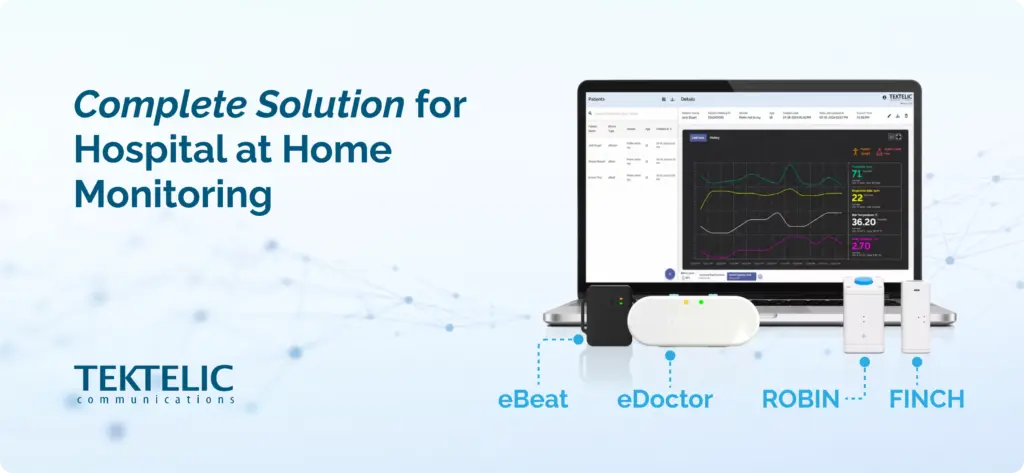
- What wearables add: intermittent pulse rate, respiration rate and skin temperature trends, plus SpO2 with eBeat, which authorized professionals review alongside other patient information.
- What they do not do: provide continuous surveillance or clinical alarms, or replace home visits, assessments, pathway equipment or the program’s escalation process.
- What the evidence shows: hospital at home can lower the cost of a care episode, but results vary by setting, and the trials do not measure the value of any single device.
- How to start: one program, one patient cohort and an agreed role for wearable data, with value measured against a baseline before expanding.
What is hospital at home?
Hospital at home is a care model in which selected patients who need hospital admission receive acute, hospital-level treatment in their own home instead of an inpatient bed, while a hospital clinical team remains responsible for their care.
Care combines in-person and remote contact: nurse and physician home visits, intravenous medication, point-of-care testing, video communication and remote monitoring [1]. In the UK and parts of Europe, similar services often run under the name virtual wards.
In the United States, the model has gained a longer planning horizon. The Acute Hospital Care at Home program, introduced by CMS in November 2020, allows approved hospitals to deliver and be paid for inpatient-level care at home. In February 2026, Congress extended it through September 30, 2030 [3], and many health systems are now moving from pilots to larger programs [4].
How hospital at home differs from other home monitoring
Hospital at home is easy to confuse with other forms of remote patient monitoring at home. The difference lies in how unwell the patient is and who holds clinical responsibility.
|
Hospital at home |
Post-discharge monitoring |
Senior care trend monitoring |
|
| The patient | Acutely ill; would otherwise be an inpatient | Recovering at home after a hospital stay | Living in a care setting or aging in place |
| Who is responsible | The hospital team, for the acute episode | The discharging team or follow-up program | The care home or home-care team |
| What wearable trends support | Reviewing patient status and treatment response between visits | Visibility between follow-up contacts | Recognizing change from a resident’s usual patterns |
|
Read more |
Post-Discharge Home Recovery |
Because hospital-at-home patients are acutely ill, the monitoring question is also more demanding than in the other two settings.

Where wearable trends fit in acute care at home
In hospital at home, wearable vital-sign trends are one layer of clinical oversight, not the whole monitoring system.
Clinical teams need to follow patient status and treatment response remotely while keeping clearly defined review and escalation workflows. Physiological trends are most useful when they sit alongside the other ways the team already learns how a patient is doing:
|
Layer of oversight |
What it gives the clinical team |
|
In-person visits |
Examination, treatment, and direct assessment |
|
Virtual assessments |
Video check-ins and conversations with the patient |
|
Point-of-care tests and pathway equipment |
Test results and the equipment each care pathway requires |
|
Wearable vital-sign trends |
Intermittent physiological readings between visits |
|
Patient-initiated contact |
A way for the patient to ask for help through the agreed response workflow |
Within this mix, wearables bring two practical benefits. First, pulse rate, respiration rate, skin temperature, and, with eBeat, SpO2 trends add context when clinicians review a patient’s status and response to treatment. Second, collecting selected measurements in a wearable form reduces dependence on fixed bedside equipment for those measurements, while the program keeps any other equipment the pathway requires.
The limits matter just as much. Wearable trends do not provide continuous surveillance or clinical alarms, and they do not replace monitoring that the devices are not designed to provide. Clinical review and response remain part of the provider’s own care model.
Device choice follows the pathway rather than defaulting to both devices. eBeat is arm-worn and adds SpO2 for pathways where oxygenation context is needed. eDoctor is chest-worn and suits pathways that do not require SpO2.
If wearables are only one layer, how should their value be judged? The starting point is understanding what the hospital-at-home model as a whole can save.
Does hospital at home save money? What the trials show
Hospital at home can cost less than inpatient care, but published trials show that results depend on the setting and on how the program is run.
Two randomized trials led by the same research group illustrate the range:
|
2020 U.S. trial [1] |
2025 rural U.S. and Canada trial [2] |
|
| Setting |
An academic medical center and a community hospital in Boston |
Three rural sites in the U.S. and Canada |
|
Patients |
91 adults with selected acute conditions |
161 adults with selected acute conditions |
| Cost result |
Adjusted direct cost of the care episode 38% lower than inpatient care (95% confidence interval, 24% to 49%); this measure excluded physician labor |
No significant difference in cost |
| Other findings |
Fewer lab orders, imaging studies and consultations; fewer 30-day readmissions |
No significant difference in 30-day readmissions; patients were more physically active and rated their experience higher |
Why the difference? In the rural trial, patients moved home relatively late in their stay, on average on day 4.2 of a 6.7-day episode, which the authors say likely reduced the effect on cost [2]. In other words, when and how patients move home is a program design decision, and it shapes the economics.
Both trials also evaluated complete care models that combined home visits, treatment and remote monitoring. They show what a well-run program can achieve, but they do not establish the independent value of any monitoring device, including TEKTELIC’s. That distinction is the basis for a credible business case.
Program savings vs the wearable’s own value
Any savings attributed to a wearable should come from evaluation, not be borrowed from the full hospital-at-home program’s benefit.
Potential value from hospital at home includes reduced inpatient bed use, lower cost per patient and greater program capacity. These are outcomes of the broader care program, not benefits a wearable can deliver on its own. A sound business case therefore answers two separate questions:
|
Question 1: Does the program pay off? |
Question 2: What does the wearable add? |
|
| What is compared |
The full cost of the hospital-at-home episode against clinically comparable inpatient care |
The program with wearable data against its existing monitoring approach |
| What to measure |
Inpatient days avoided or replaced, transfers back to hospital, and total cost per completed episode, including clinical services, equipment, connectivity, software, deployment, training, support and staff review |
Device purchase, reuse, replacement, cleaning and turnaround costs; staff time spent on review, visits, coordination and support; caseload per clinical team |
| Common mistake |
Treating released bed capacity as a budget saving |
Assuming lower staffing or care costs before they are validated |
Two principles keep the numbers reliable. First, released bed capacity, avoided costs and actual budget savings should be reported separately, because freeing a bed does not automatically reduce spending. Second, reductions in utilization, staffing or care costs should be confirmed against an agreed baseline rather than assumed.
Program capacity deserves its own attention. Tracking patients supported, completed care episodes and caseload per clinical team shows whether wearable information helps keep caseloads manageable and staff activity focused, or whether review, visits or technical support become the factor that limits growth.
How wearable trends reach remote clinical review
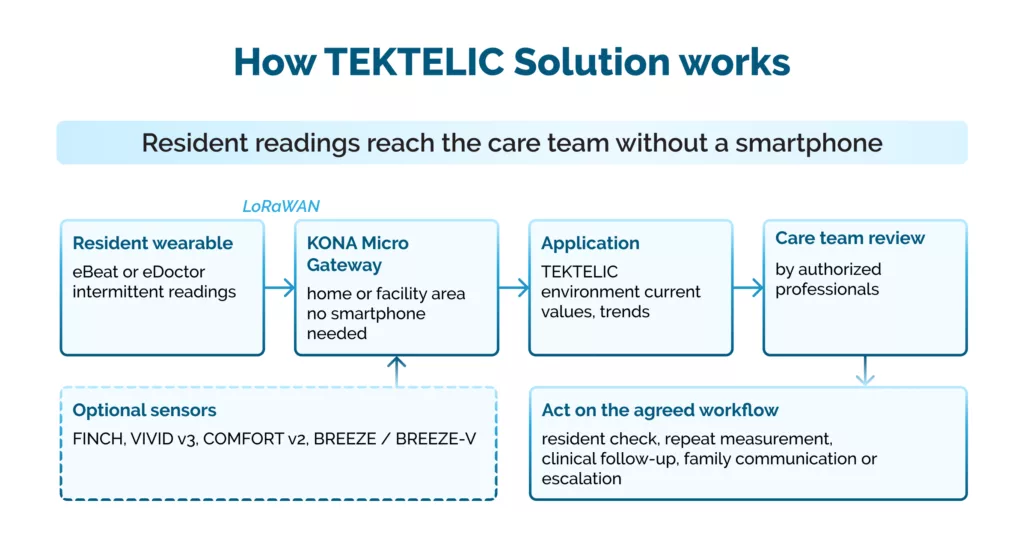
Wearable data reaches clinicians through a gateway in the patient’s home, but decisions are made in the program’s own review and escalation workflow.
How wearable trends reach remote clinical review
Measurements travel over LoRaWAN through a preconfigured KONA Micro Gateway to the TEKTELIC application, so patients do not need to own, pair, charge or operate a smartphone. Our post-discharge article explains this setup in more detail. In the application, authorized professionals review current measurements and historical trends across their patients, then act through the program’s agreed workflow.
Where a program needs the data in its existing clinical or virtual-care platform, the integration is scoped and validated before patients use it. Optional FINCH, VIVID or COMFORT devices can add call-for-help, presence, activity, door or environmental context. They remain secondary to eBeat and eDoctor and do not replace the program’s clinical escalation process.
Decisions to make before the first patient goes home
Acute episodes at home are short, so roles, rules and support need to be agreed before the first patient is enrolled, not worked out during the episode.
|
Decision |
Why it matters in hospital at home |
| Monitoring cadence | The parameters and measurement frequency should support a defined patient pathway and treatment-review objective. Supported measurement settings are confirmed before deployment. |
| Review and documentation | The team agrees where trends are reviewed, how often, who documents them and when a reading is verified manually. |
| Missing or delayed data | A gap in data needs a known response agreed in advance, so it is never mistaken for a sign that the patient is stable. |
| Reassessment and escalation | Trends feed into the program’s existing criteria for patient assessment and escalation; they do not set those criteria. |
| Equipment turnaround | Devices move between patients after short episodes, so setup, cleaning, replacement and return each need an owner. |
| Integration | If clinicians need the data inside an existing clinical or virtual-care platform, that integration is scoped and validated before patient use. |
| Support and handoff | Responsibilities for training, technical support,87ytfc and clinical handoff are defined up front. |
Once these are in place, a focused start keeps risk and effort low: one hospital-at-home program, one defined patient cohort and an agreed role for wearable data. Before deployment, the team confirms home connectivity, wear comfort and baseline measures. Expansion follows only after patient acceptance, data delivery, staff workload, program fit and incremental value have been validated.
Planning or scaling a hospital-at-home program?
Contact TEKTELIC to discuss where wearable vital-sign trends could support remote clinical review in your pathway or explore TEKTELIC healthcare solutions.