Expertise
5 min reading
6 November 2026
6 November 2026
Soil Moisture Sensors: How to Choose, Deploy and Read Them

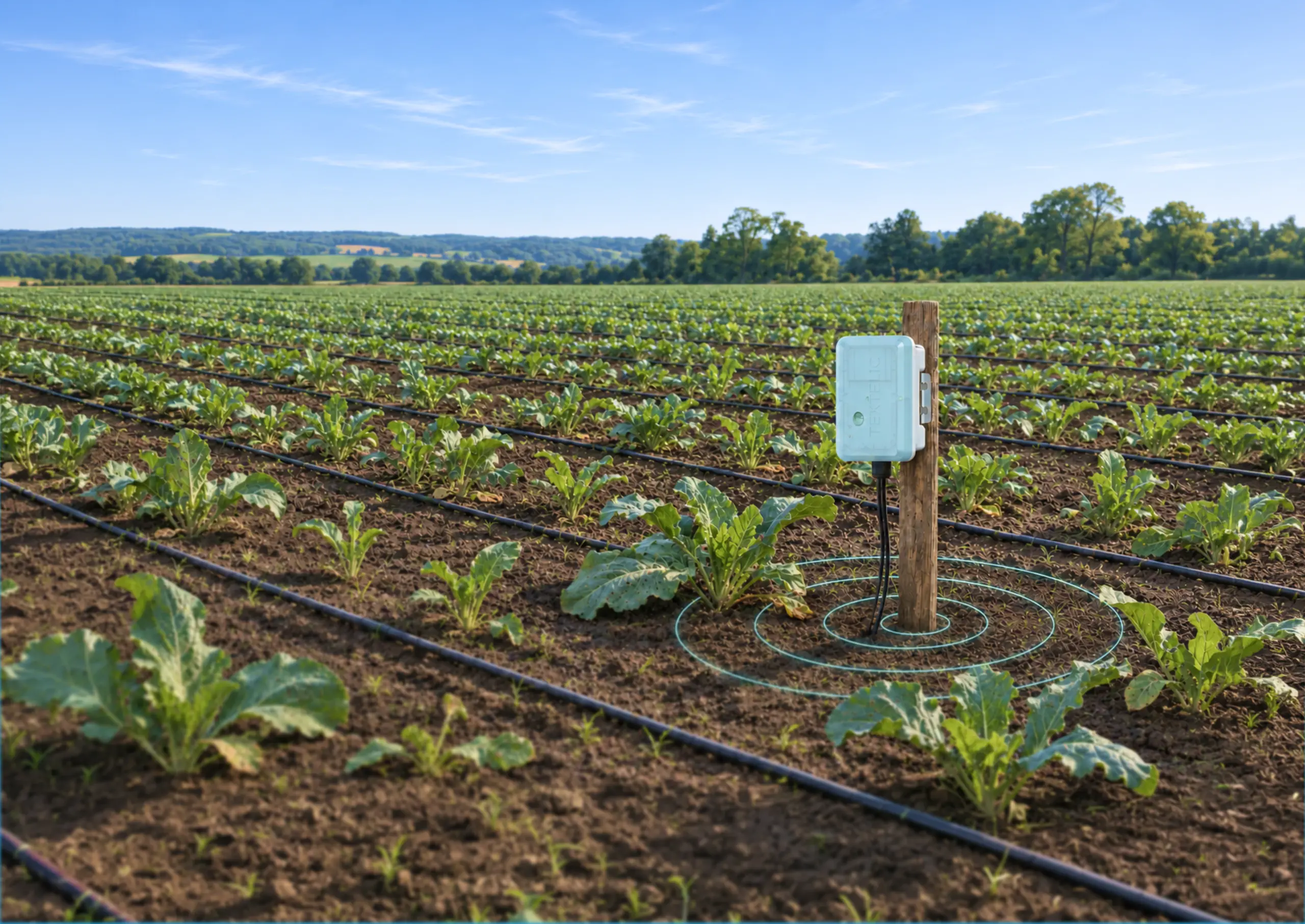
A soil moisture sensor is a device placed in the root zone that measures how much water the soil holds, or how hard plant roots must pull to get it, and reports that as a number you can act on. Also called soil moisture probes or soil water sensors, they replace the guesswork behind most irrigation decisions with readings from the field itself.
That guesswork is still common. Many growers irrigate on a fixed schedule, after a look at the surface, or from a single reading taken by hand. None of these show whether water actually reached the deeper roots, whether it drained past them, or whether the roots can still extract what is left. Answering those questions takes a sensor in the right place, at the right depth, and reading the right way.
This guide covers all three steps. It explains how the main sensor types work, what to compare when you choose one, how to deploy soil moisture sensors in the field, and how to turn the readings into irrigation decisions. For the wider picture of how sensors fit into a connected farm, see our overview of IoT sensors in agriculture.
How do soil moisture sensors work?
Every soil moisture sensor measures one of two things: how much water the soil contains, or how tightly the soil holds that water. The first is volumetric water content; the second is soil water tension. Knowing which one a sensor reports is the starting point for choosing it and for reading its data.
Volumetric water content vs soil water tension
Volumetric water content (VWC) is the share of a soil volume taken up by water, expressed as a percentage. VWC tells you how much water is in the ground. What it cannot tell you on its own is whether plants can use that water. A sandy soil and a clay soil at the same VWC behave very differently, because clay holds water far more tightly.
Soil water tension, also called soil matric potential, closes that gap. It measures the force roots must apply to pull water from the soil, in kilopascals (kPa) or centibars (1 kPa = 1 centibar). Tension reads 0 kPa when the soil is saturated and rises as the soil dries. Because it describes what the plant actually experiences, a tension reading means much the same thing across soil types, which makes it the more direct guide to irrigation timing.
Types of soil moisture sensors
Five sensor technologies cover most field use. Capacitance and TDR sensors report VWC; tensiometers and granular matrix sensors report tension.
|
Sensor type |
What it measures | How it works | Strengths | Limitations |
Typical fit |
| Capacitance / FDR (capacitive soil moisture sensor) |
VWC |
Measures the soil’s dielectric permittivity, which rises with water content | Fast, low maintenance, easy to log continuously | Sensitive to soil contact, salinity and soil-specific calibration |
Continuous monitoring, multi-depth capacitance probes |
| Time domain reflectometry (TDR) |
VWC |
Times an electrical pulse along a buried waveguide | High accuracy, less soil-dependent | Higher cost, more complex electronics |
Research and high-value crops |
| Tensiometer |
Tension |
A water-filled tube with a porous ceramic tip equalizes with the surrounding soil | Direct tension reading, no calibration | Works only in the wetter range, needs refilling and upkeep |
Wet-range crops such as vegetables and turf |
| Granular matrix sensor (e.g. Watermark) |
Tension |
Electrical resistance across a granular matrix changes as it wets and dries with the soil | Durable, wide range, inexpensive, low maintenance | Slower response, less precise near saturation |
Field crops, orchards, vineyards |
| Resistive (bare electrode) |
Relative wetness |
Measures resistance between two exposed electrodes | Very cheap | Electrodes corrode, readings drift, strongly affected by salts |
Hobby and short-term use only |
For commercial irrigation, the choice usually comes down to capacitance for continuous water content, or granular matrix sensors for tension across the full irrigation range. The next section shows how to decide between them.
How to choose soil moisture sensors for agriculture
The best soil moisture sensor is the one that answers your irrigation question in your soil, at the depths your crop uses, without someone walking the field to read it. Six criteria decide that.
- The question you need answered. If you need to know when to irrigate and how deep the water went, measure tension at more than one depth. If you need a day-to-day check that a surface layer stays in range, as on turf or greens, water content at the surface is enough.
- Your soil and crop. Soil texture sets how much water is available to plants and at what tension. Fields with mixed textures need a sensor site per texture, and deep-rooted perennials such as vines and fruit trees need readings deeper than shallow vegetables do.
- Depth coverage. One probe shows one spot. Two or more depths show water moving through the root zone, which is what tells you whether an irrigation was long enough.
- Extra parameters. Soil temperature affects root activity and sensor readings, while air temperature, humidity and sunlight drive how fast the crop uses water. A sensor that reports these alongside soil moisture saves a separate weather station for many blocks.
- Durability and power. Field units face sun, rain, frost and machinery. Look for an IP67 enclosure and battery life measured in years, so the sensor runs through several seasons without service.
- Connectivity and total cost. Price the whole system, not the probe: sensor, network, data platform and labor. A cheap sensor that someone must read by hand every week costs more over a season than a wireless one.
Sensor or handheld soil moisture meter?
A handheld meter gives a spot reading wherever you push it in, which is useful for checking a single plant or calibrating your eye. It cannot show trends, catch overnight drying, or tell you what happened at 60 cm after last night’s irrigation. Permanent sensors can, which is why they are the basis of irrigation scheduling.
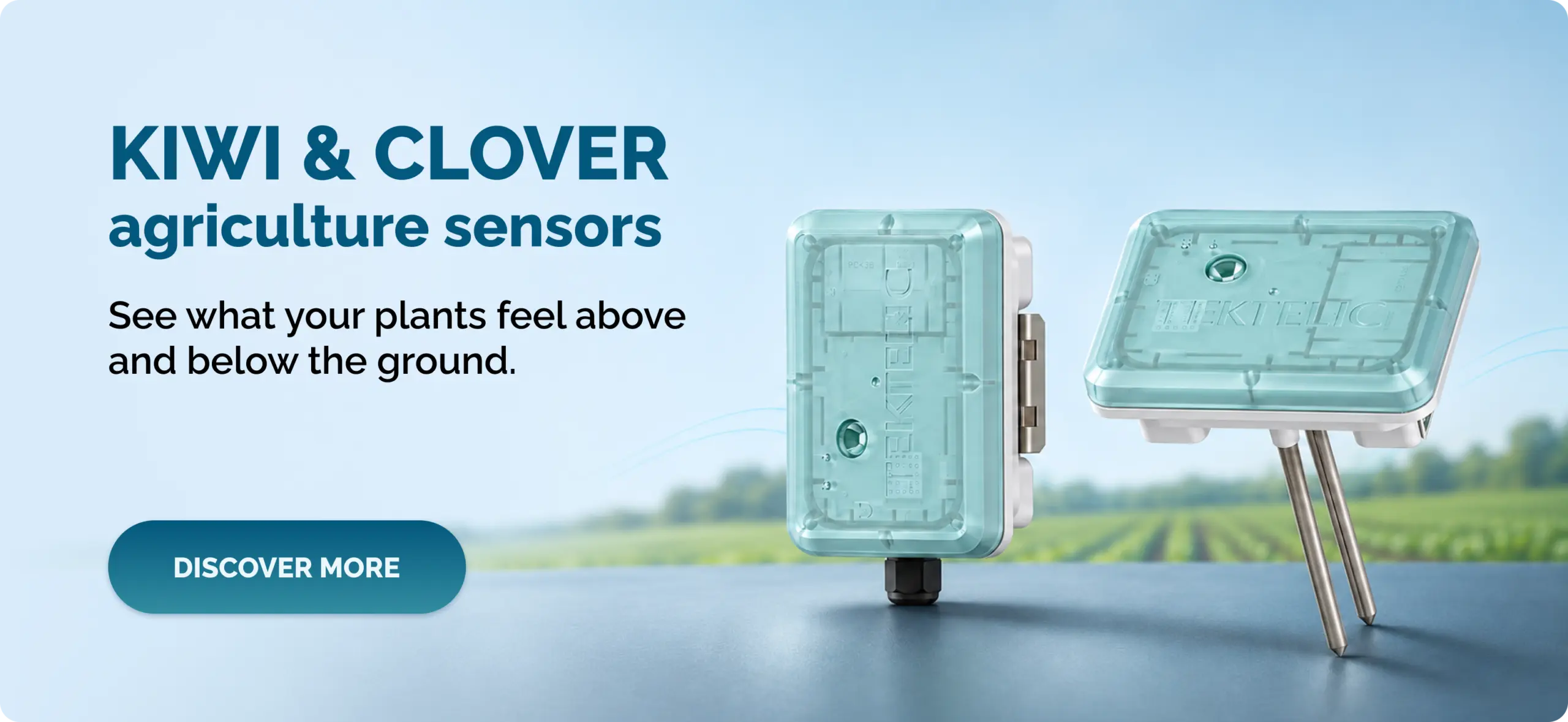
TEKTELIC builds two LoRaWAN soil sensors around these criteria. KIWI measures soil water tension and soil temperature at two depths, plus air temperature, humidity and sunlight, for vineyards, orchards, vegetables and greenhouses. CLOVER is its surface-mount sibling: built-in prongs push straight into the ground to measure moisture content and temperature for turf, lawns and golf greens.
Once you know which measurement you need, the next decision is how the data will reach you.
Wireless soil moisture sensors: IoT and LoRaWAN
A soil moisture monitoring system is only as useful as the data that reaches the person making the irrigation decision. Wired loggers and manual reads break down once sensors are spread across many blocks or kilometers of field, and Wi-Fi or Bluetooth do not reach that far. That is why most commercial deployments now use wireless soil moisture sensors on a low-power wide-area network.
LoRaWAN is the most common choice for farms because it was built for exactly this trade-off: small amounts of data, sent over long distances, from battery-powered devices that stay in the field for years. A typical LoRaWAN soil moisture sensor setup has four parts:
- Sensors in the field read soil and air conditions and transmit a few bytes at set intervals.
- A gateway on a pole, roof or wall receives those transmissions. A single outdoor LoRaWAN gateway can cover up to 15 km, depending on terrain.
- A network server authenticates devices and routes their data.
- An application or dashboard turns readings into trends, zone comparisons and alerts.
Because LoRaWAN is an open standard, sensors and gateways from different vendors work together, and farms can run a private network or join a public one. To estimate how many gateways a given area needs, use our LoRaWAN gateway and network cost calculator.
The approach has been proven in difficult terrain. In the mountains around Resende, Portugal, fruit grower Cerasus deployed TEKTELIC CLOVER and KIWI sensors over LoRaWAN to guide irrigation and meet the requirements of SPRING water-stewardship certification, while cutting the number of field visits.
With the network question settled, what remains is putting the sensors where they will tell the truth about the field.
How to deploy soil moisture sensors
A well-chosen sensor in the wrong spot gives confident, wrong answers. Placement and installation matter as much as the hardware, and the steps below apply to most tension and water-content sensors.
- Map your management zones. Place at least one sensor site in each area you irrigate differently. If you have only one site, it should represent the soil texture that covers most of the field; fields with variable textures need more sites.
- Pick a representative spot. Install in the crop row, within the wetted area of drip emitters or sprinklers, and away from field edges, wheel tracks, low spots and unusually strong or weak plants.
- Set the depths to the root zone. Put the upper probe where most active roots are and the deeper probe near the bottom of the root zone. Extension programs often use several depths; the University of Arkansas, for example, describes 6, 12, 18 and 30 inch configurations, with 6, 12 and 24 inches as an alternative. Shallow-rooted vegetables need shallower probes than vines or fruit trees.
- Prepare the probes. Granular matrix sensors such as Watermark should be soaked and installed wet, which shortens the time they need to equalize with the soil.
- Install with full soil contact. Good contact between probe and soil is essential for accurate readings. Use a dedicated installation tool or auger, backfill with a slurry of native soil, and avoid air gaps along the probe.
- Mount and connect the unit. An elevated device such as KIWI mounts on a post or trellis above the canopy, with cabled probes running to each depth. A surface unit such as CLOVER pushes straight into the ground with no cables or posts.
- Commission and verify. Join the sensor to the network, then check readings after the next irrigation or rain. Both depths should respond in sequence; if the deeper probe never reacts, the probe or the irrigation needs a second look.
- Leave it in for the season. Sensors are designed to stay in the ground through the growing season. Check trigger readings against crop appearance as the season progresses, and remove the probes before tillage or harvest traffic.
Once the probes are in place and reporting, the readings start to build a record of how water moves through your soil. Reading that record well is where the irrigation savings come from.
How to read soil moisture sensor data
Soil moisture readings make sense only against the limits of your soil: how much water it can hold after drainage, and the point at which plants can no longer extract any. Between those limits lies the water your crop can actually use.
Field capacity, wilting point and plant-available water
- Field capacity is the water left in the soil once free drainage stops, a day or two after a soaking. In tension terms it ranges from about 10 kPa in light soils to about 33 kPa in heavy soils.
- Permanent wilting point is the level at which plants can no longer pull water from the soil, about 1,500 kPa.
- Plant-available water is everything between the two. Irrigation aims to refill the root zone toward field capacity before the crop uses up so much of this water that it becomes stressed.
What tension readings mean
|
Soil water tension (kPa = centibars) |
What it means |
|
0 |
Saturated: soil pores are full of water |
|
10–33 |
Around field capacity, from light to heavy soils |
|
20–40 |
Common irrigation trigger in most soils other than heavy clay |
|
60–105 |
Triggers reported for heavier or drier-managed fields, e.g. about 60 kPa in sandy loam and 105 kPa in clay loam for sugarbeet |
|
200 |
Upper end of a granular matrix sensor’s range |
| 1,500 |
Permanent wilting point, beyond any field sensor’s range |
The right trigger depends on crop, growth stage, and soil, so treat these ranges as a starting point and confirm them against how the crop looks during the season.
What is a good soil moisture percentage?
There is no single figure. For VWC sensors, “good” is the band between your soil’s field capacity and its refill point, and those values differ widely between sand and clay. That is one reason many growers prefer tension: its ranges carry over between soils far better than percentages do.
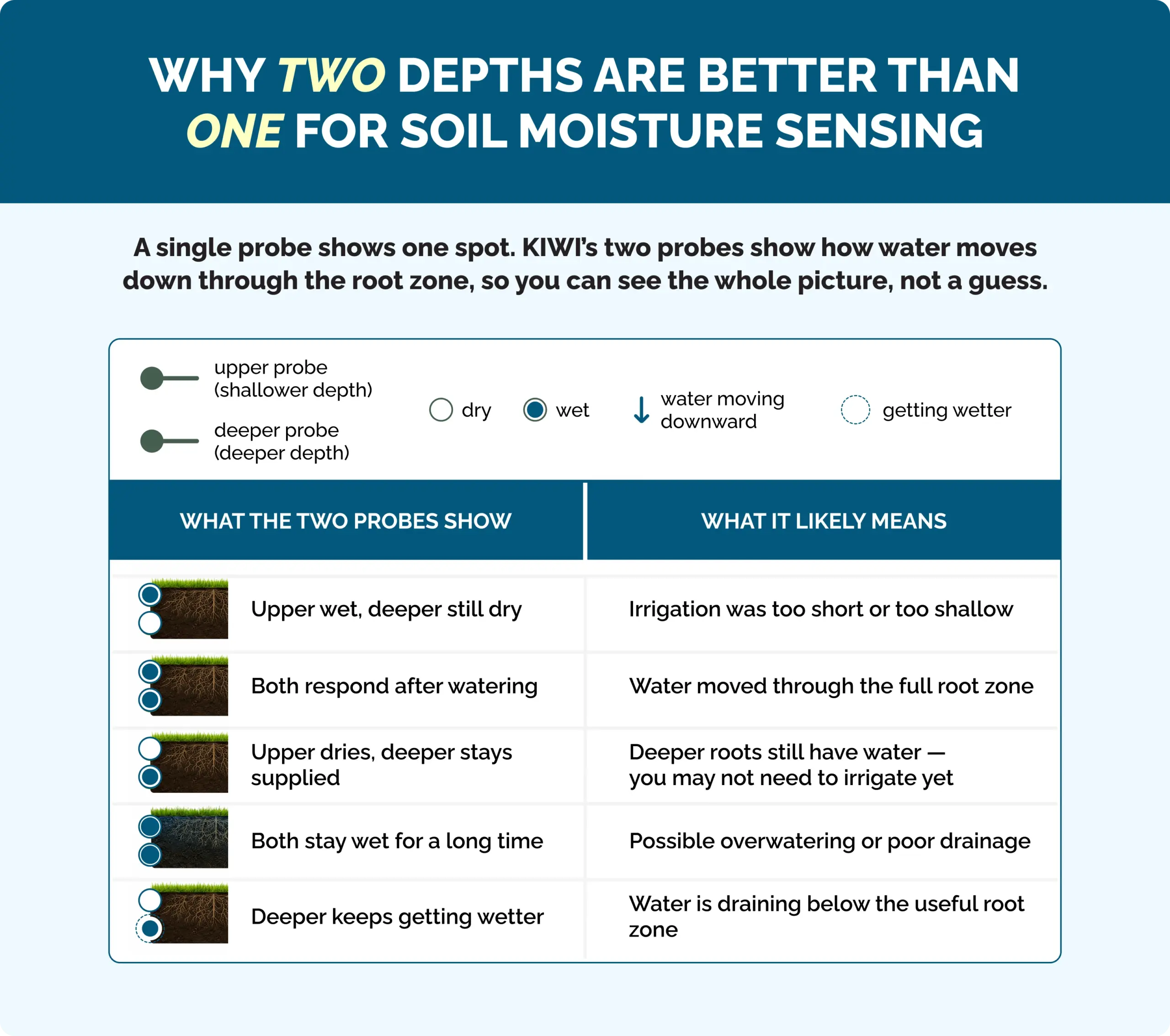
What two depths tell you
Readings from two depths become far more useful when you compare them, because the pattern between them shows where the water went.
Read trends
One reading is a snapshot. The useful signals are the rate at which tension climbs between irrigations, how quickly each depth responds after water is applied, and how those patterns change as the crop grows and temperatures rise. A dashboard that plots both depths over time, compares zones and sends an alert when a trigger is crossed makes these patterns visible without anyone opening a spreadsheet.
KIWI pairs those soil readings with air temperature, humidity and sunlight from the same device, so you can see why a block dried faster than usual on a hot, bright day. See how KIWI reports two-depth soil water tension.
Using soil moisture sensors for irrigation scheduling
Irrigation scheduling with soil moisture sensors comes down to two rules: start when the root zone reaches its trigger, and stop once water has reached the bottom of the root zone but before it drains past it. Everything in the previous sections feeds those two decisions.
- When to start. Irrigate when tension in the main root zone reaches the trigger for your crop and soil. Before the crop’s reproductive stages, extension guidance suggests basing the trigger on the average of the sensors in the top 2 feet of soil.
- How long to run. Watch the deeper probe. When it responds, water has reached the bottom of the root zone; if it keeps getting wetter on later irrigations, shorten the run.
- How to adjust through the season. Re-check triggers as roots deepen, temperatures rise and the crop moves between growth stages. Sensors also pair well with evapotranspiration estimates: sensors decide when to irrigate, while evapotranspiration helps estimate how much water the crop used since the last one.
The result is water applied on crop demand rather than on the calendar. In Bulgaria, Loren Networks deployed TEKTELIC KIWI sensors across a large watermelon and cabbage operation, letting the grower tailor water to each crop area based on real-time soil data. The outcome was better water conservation, lower costs and healthier crops.
The same LoRaWAN network that carries soil data can follow the crop after harvest. TUNDRA tracks temperature and humidity in cold rooms and transport, storing about 3,000 readings so no data is lost during connectivity gaps. Adding it to an existing farm network extends monitoring from the root zone to the cold chain without new infrastructure.
Ready to schedule irrigation on real field data? Explore TEKTELIC solutions for agriculture.
From readings to irrigation decisions
Soil moisture sensors pay off when three choices line up: the right measurement for your question, probes placed at the depths your crop uses, and readings interpreted against your soil’s limits. Tension at two depths times each irrigation and sizes it; surface water content keeps turf and greens in range day to day. A LoRaWAN network then delivers every reading to one dashboard, from blocks a grower might otherwise visit once a week.
TEKTELIC brings those pieces together on one long-range, low-power network: KIWI reads the root zone, CLOVER reads the surface, TUNDRA guards the cold chain after harvest, and KONA gateways connect them across the farm.